
Scaling
Medical Practice Consulting Maryland: Practice Growth, Valuation & Exit Guide

Looking for medical practice consulting Maryland? Learn how practice management, AI, valuation, EBITDA, MSPs and exit planning can help build a more profitable healthcare business.
Medical Practice Consulting Maryland: Why Healthcare Business Owners Need More Than Clinical Expertise
If you are searching for medical practice consulting Maryland, you may be dealing with a challenge that many successful physicians and healthcare entrepreneurs eventually encounter: the practice is growing, but the business is becoming increasingly difficult to manage.
Revenue may be increasing.
The patient base may be growing.
You may have hired more providers.
You may even have opened another location.
Yet the owner still feels responsible for almost every important decision.
That is where strategic medical practice consulting Maryland can make a significant difference.
Medical practice consulting is not simply about improving scheduling, billing or administrative procedures. The right consulting strategy should help transform a healthcare practice from an owner-dependent operation into a professionally managed business with stronger systems, predictable performance, scalable operations and increasing enterprise value.
This distinction is important because clinical success does not automatically create business success.
A physician can deliver exceptional patient care and still struggle with:
- declining margins;
- staffing challenges;
- inefficient operations;
- revenue leakage;
- weak patient acquisition;
- poor follow-up;
- administrative overload;
- technology gaps;
- owner dependence;
- inconsistent financial reporting;
- limited management depth;
- and an unclear exit strategy.
Your Lifestyle Navigator approaches this problem from a broader perspective: helping healthcare and behavioral health entrepreneurs Navigate business growth, Elevate wealth, prepare their eXit, and Transfer their legacy through the NEXT Framework.
This comprehensive guide explains what medical practice consulting involves, how it differs from a medical management company or MSP, how physicians can improve profitability, how behavioral health practice valuation works, what EBITDA means, and how Maryland healthcare owners can begin preparing for long-term growth and exit readiness.
What Is Medical Practice Consulting?
Medical practice consulting is the process of helping healthcare organizations improve their business strategy, operations, financial performance, technology, leadership, growth and long-term enterprise value.
A medical practice consultant does not replace the physician's clinical expertise.
Instead, the consultant focuses on the business infrastructure surrounding clinical care.
That may include:
- strategic planning;
- operational optimization;
- revenue-cycle improvement;
- staffing;
- leadership development;
- financial performance;
- technology;
- AI implementation;
- marketing;
- patient acquisition;
- referral development;
- workflow automation;
- practice valuation preparation;
- succession planning;
- and exit planning.
The fundamental question is:
How can the healthcare practice produce better business results without requiring the owner to personally control every part of the organization?
That question becomes increasingly important as a practice grows.
A physician who personally manages scheduling, employees, billing issues, vendors, marketing, technology, recruiting and strategic decisions may successfully operate a small practice.
But that model becomes difficult to scale.
Eventually, the owner must transition from being the person who does everything to the person who builds the system that makes everything work.
Why Maryland Healthcare Practices Need Strategic Management
Maryland healthcare entrepreneurs operate in an environment where clinical delivery and business management increasingly overlap.
A practice owner must think about:
- reimbursement;
- staffing;
- technology;
- compliance;
- patient experience;
- referral sources;
- marketing;
- operational efficiency;
- financial performance;
- and long-term business value.
The challenge is that most healthcare professionals were trained to become excellent clinicians—not necessarily CEOs.
This creates a common progression:
Clinician → Practice Owner → Employer → Operator → CEO
The transition from practitioner to CEO requires a different set of capabilities.
If you are currently making that transition, YLN's guide on Moving From a Healthcare Practitioner to a CEO: The Complete Leadership Roadmap is a useful companion resource.
The fundamental lesson is simple:
The bigger the practice becomes, the less the owner can rely on personal effort as the primary growth strategy.
Medical Practice Management Consulting Maryland: What Does It Actually Include?
When healthcare owners search for medical practice management consulting Maryland, they may encounter very different types of providers.
Some specialize in medical billing.
Some specialize in staffing.
Some provide technology.
Some operate as MSOs.
Others focus on strategic business consulting.
A comprehensive practice-management strategy can involve several layers.
1. Business Strategy
A consultant should help answer:
- Who is the practice serving?
- What makes the organization different?
- Where should revenue come from?
- Which services are most profitable?
- Which services should be expanded?
- Which locations should be developed?
- What should the practice look like in three to five years?
Without strategic direction, growth can create complexity rather than wealth.
2. Operational Management
Operational consulting examines how work moves through the organization.
For example:
Lead → Inquiry → Appointment → Service → Billing → Collection → Follow-up → Retention
Every handoff creates the possibility of delay or revenue leakage.
The objective is to identify those bottlenecks and redesign the workflow.
3. Leadership Development
A growing practice needs more than additional employees.
It needs leaders.
Depending on size and specialty, that could include:
- practice administrator;
- operations director;
- clinical director;
- finance leader;
- billing manager;
- marketing manager;
- HR support;
- technology leadership.
The goal is to create accountability throughout the organization.
4. Technology and AI
Technology should not be implemented simply because it is popular.
The right question is:
Which repetitive or inefficient business processes are costing us time, money or growth opportunities?
AI can potentially support:
- lead qualification;
- appointment reminders;
- scheduling;
- administrative communication;
- revenue-cycle processes;
- documentation workflows;
- reporting;
- staff productivity;
- patient engagement;
- and operational analytics.
YLN has a dedicated guide explaining The Importance of AI in Healthcare Operations, including implementation considerations, workflow opportunities and compliance concerns.
Medical Practice Consultant Maryland vs. Practice Management Company
One of the most important distinctions healthcare owners should understand is the difference between a consultant and a practice management company.
They can overlap, but they are not necessarily the same.
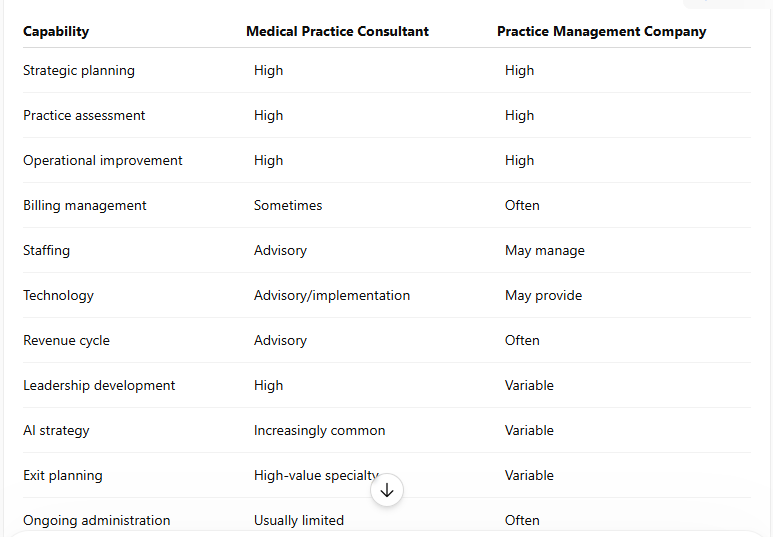
consultant may help the owner determine what needs to change and how to implement it.
A management company may actually take responsibility for operating certain parts of the business.
Neither model is universally better.
The right choice depends on the organization's needs.
For a broader look at the Maryland market, see YLN's Top Medical Practice Management Companies in Maryland. That article examines practice-management providers, MSOs, technology, revenue-cycle services and the questions owners should ask before choosing a partner.
Physician Practice Consulting Maryland: When Should You Hire a Consultant?
Physicians often wait until a problem becomes serious before seeking professional business advice.
That can be expensive.
A better strategy is to recognize the early warning signs.
You may benefit from physician practice consulting Maryland support if:
- revenue is increasing but profit is not;
- you work significantly more hours than you want;
- employees constantly ask you to make decisions;
- the practice cannot function without you;
- administrative work consumes clinical or leadership time;
- staffing problems are recurring;
- patient acquisition is unpredictable;
- referrals are concentrated in a few sources;
- billing performance is inconsistent;
- your practice lacks reliable KPIs;
- you are considering another location;
- you are preparing for a partnership;
- you are considering selling;
- or you want to build wealth outside the practice.
The key question is not:
"Does my practice have problems?"
Every growing organization has problems.
The better question is:
"Are these problems reducing the future value of my business?"
What Is a Physician Practice Management Company?
A physician practice management company typically provides administrative, operational, financial or strategic support to physician practices.
Depending on the organization, services can include:
- billing;
- credentialing;
- revenue-cycle management;
- scheduling;
- human resources;
- purchasing;
- IT;
- compliance;
- marketing;
- financial reporting;
- and administrative management.
Some organizations operate through an MSO — Management Services Organization — model.
MSOs can provide non-clinical infrastructure while allowing physicians and appropriate professional entities to retain clinical responsibilities.
However, healthcare owners should obtain qualified legal advice before entering an ownership or management structure because healthcare laws and corporate-practice restrictions can vary by jurisdiction and transaction structure.
Medical Management Companies: What Should You Evaluate?
Searching for medical management companies is only the beginning.
The more important question is:
Which type of management partner does my practice actually need?
Before signing a contract, evaluate the following.
Healthcare specialization
Does the company understand your specialty?
Behavioral health, primary care, cardiology, dermatology and other specialties have different operational and financial realities.
Technology
Can the provider integrate your:
- EHR;
- CRM;
- billing system;
- scheduling;
- analytics;
- automation;
- communication tools?
Financial visibility
Can you see:
- revenue;
- margins;
- provider productivity;
- accounts receivable;
- collection performance;
- service-line profitability?
Leadership
Does the organization help you develop managers who can make decisions without constantly escalating everything to the owner?
Long-term value
Does the management strategy improve the practice's potential enterprise value?
That last question is frequently overlooked.
Best MSP for Healthcare in Maryland: How Is an MSP Different?
The keyword best MSP for healthcare in Maryland has a different intent from medical practice consulting.
MSP means Managed Service Provider.
An MSP primarily focuses on technology infrastructure and IT services.
Healthcare MSP services may include:
- cybersecurity;
- managed networks;
- cloud infrastructure;
- backups;
- help desk;
- device management;
- monitoring;
- disaster recovery;
- EHR technical support;
- and security controls.
A medical practice consultant, by contrast, is generally focused on the broader business.
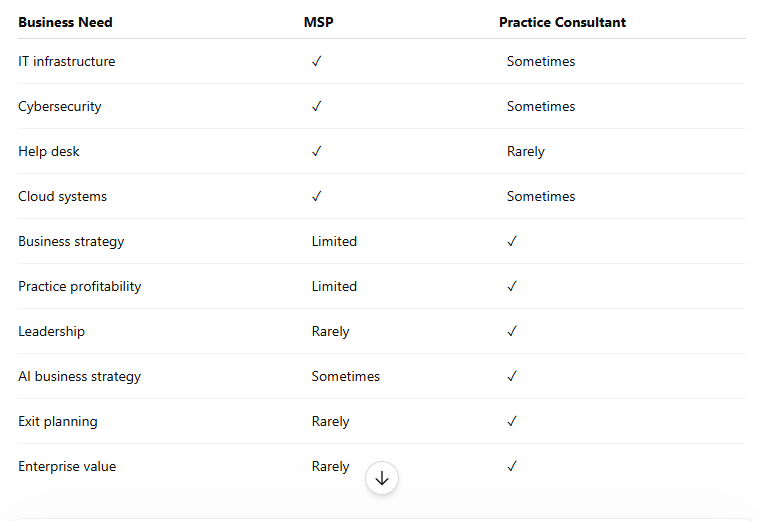
The best solution may therefore involve both.
Your MSP keeps the technology environment functioning and secure.
Your healthcare business advisor helps determine how that technology should contribute to growth, efficiency and enterprise value.
Behavioral Health Practice Valuation: What Is Your Practice Worth?
For behavioral health owners, one of the most important strategic questions is:
What is my practice actually worth?
That is where behavioral health practice valuation becomes important.
A valuation is not simply:
Revenue × multiple
Professional buyers may examine:
- adjusted EBITDA;
- provider dependence;
- owner dependence;
- payer mix;
- revenue concentration;
- provider retention;
- management depth;
- geographic footprint;
- referral concentration;
- compliance;
- growth;
- financial reporting;
- and the sustainability of earnings.
This means two practices with identical revenue can potentially have dramatically different valuations.
Behavioral Health Practice EBITDA Multiples: Why They Matter
One of the most common valuation concepts is EBITDA.
EBITDA = Earnings Before Interest, Taxes, Depreciation and Amortization.
EBITDA is often used to compare operating performance and establish a starting point for enterprise valuation.
But EBITDA is not the same as cash flow, owner compensation or final purchase price.
A buyer may normalize EBITDA by adjusting certain expenses or owner-specific items.
That is why clean financial reporting is so important.
Current published behavioral-health market sources show that transaction multiples vary significantly depending on size, specialty, scale, profitability and business quality. Smaller owner-dependent practices can trade at lower multiples, while larger, diversified platforms with stronger management infrastructure may command substantially higher multiples.
Illustrative valuation framework
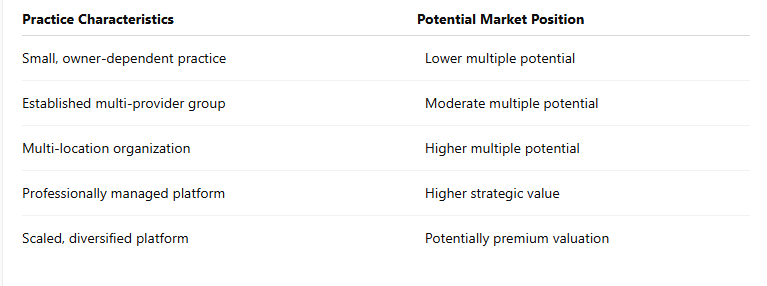
These are illustrative categories rather than guaranteed valuation multiples.
The correct valuation depends on the actual business, financials, transaction structure and market conditions.
For owners considering a future sale, YLN's Preparing Behavioral Healthcare Practice For Sale provides a deeper discussion of financial preparation, founder dependence, payer mix, management infrastructure and buyer due diligence.
What Increases Behavioral Health Practice Valuation?
A healthcare practice becomes more attractive to buyers when its earnings are predictable, transferable and scalable.
1. Reduced Owner Dependence
If every important decision requires the founder, the business carries significant key-person risk.
A buyer wants to know:
Can this organization continue performing if the owner is no longer involved in daily operations?
2. Strong Provider Retention
In behavioral health, clinicians are closely connected to revenue production.
A practice with strong recruitment and retention systems can therefore be more attractive than one constantly losing providers.
3. Diversified Revenue
A practice that depends heavily on one payer, referral source, provider or customer segment may carry more risk.
Diversification can improve resilience.
4. Reliable Financial Reporting
Buyers need to understand:
- revenue;
- expenses;
- EBITDA;
- payer mix;
- service-line performance;
- accounts receivable;
- growth trends.
If the owner cannot confidently explain the numbers, the buyer may become cautious.
5. Management Depth
A business with a capable leadership team is easier to scale and transition.
This is one reason owners should build management infrastructure before they decide to sell.
Revenue Growth Does Not Automatically Equal Business Value
Consider two hypothetical practices.
Practice A
Revenue: $3 million
- Founder makes most decisions
- Heavy owner involvement
- Weak reporting
- High provider turnover
- One major referral source
- Limited management
Practice B
Revenue: $2.5 million
- Strong management team
- Diversified referrals
- Stable providers
- Reliable reporting
- Documented workflows
- Automated administrative processes
Which business is necessarily more attractive?
Revenue alone cannot answer that question.
Enterprise value depends on the quality and sustainability of the earnings.
The objective should therefore be to build a business that produces revenue through systems, rather than a business where revenue exists primarily because the owner personally works harder.
How AI Can Improve Medical Practice Operations
AI is increasingly becoming part of healthcare business operations.
But healthcare owners should avoid implementing AI simply because it is fashionable.
Instead, identify the highest-value operational bottlenecks.
For example:
Lead Management
Inquiry → Qualification → Appointment → Follow-up
AI can help automate parts of the process.
Patient Communication
Automated systems can assist with appropriate reminders and communication workflows.
Revenue Cycle
Technology can help identify administrative inefficiencies and repetitive tasks.
Scheduling
Automation can reduce manual scheduling and reminder workloads.
Reporting
AI-enabled analytics can help leadership identify trends and exceptions.
However, AI implementation must be approached carefully where protected health information, clinical decision-making, privacy, security or regulatory obligations are involved.
Read YLN's comprehensive AI in Healthcare Operations guide for a deeper look at healthcare AI implementation, workflow automation and risk management.
From Healthcare Practitioner to CEO
One of the biggest transformations a healthcare entrepreneur can make is moving from practitioner thinking to CEO thinking.
A practitioner asks:
"How can I serve this patient?"
A CEO must also ask:
"How do I build an organization that consistently delivers excellent care while remaining financially sustainable?"
The CEO must think about:
- people;
- systems;
- cash flow;
- technology;
- marketing;
- operations;
- culture;
- strategy;
- growth;
- risk;
- and enterprise value.
This does not mean becoming less focused on patients.
It means building the business infrastructure that allows the organization to serve more people effectively.
For a detailed roadmap, read YLN's Moving From a Healthcare Practitioner to a CEO: The Complete Leadership Roadmap.
How to Build an Exit-Ready Medical Practice
You do not need to be planning a sale today to start building an exit-ready business.
In fact, waiting until you are ready to sell may be one of the biggest mistakes an owner can make.
Exit readiness involves building the organization so that someone else could reasonably acquire or take over it.
That means developing:
- clean financials;
- documented processes;
- management depth;
- strong provider retention;
- diversified revenue;
- stable referral sources;
- technology infrastructure;
- compliance documentation;
- reliable KPIs;
- and a clear growth story.
YLN's Healthcare Practice Exit Planning in Maryland & Virginia explores these issues in more detail, including Maryland and Virginia considerations around ownership, regulatory issues and transition planning.
Why Exit Planning Should Begin Before You Need an Exit
Imagine two owners.
Owner A
"I want to sell next year. Let's figure out what my practice is worth."
Owner B
"I may sell in five years. Let's start building the business today so that it will be attractive to buyers."
Owner B has more time to:
- improve EBITDA;
- reduce owner dependence;
- strengthen management;
- diversify revenue;
- fix compliance issues;
- improve financial reporting;
- build growth systems;
- and demonstrate consistent performance.
Time is therefore an asset in exit planning.
The NEXT Framework for Healthcare Business Growth
Your Lifestyle Navigator's approach is built around the NEXT Framework:
N — Navigate Business Growth
Build the strategy, systems and operational foundation required for sustainable growth.
E — Elevate Wealth
Turn business success into personal wealth rather than allowing all financial value to remain trapped inside the practice.
X — eXit Strategy
Prepare the owner, business, leadership team and financial infrastructure for a future sale, succession or transition.
T — Transfer Legacy
Design what happens to the wealth, business and impact after the owner's active involvement changes.
YLN describes the framework as an integrated pathway for launching, scaling, protecting, exiting and transferring the value created by healthcare entrepreneurs.
This is important because practice growth should not be treated as an isolated financial objective.
The bigger question is:
What is the business supposed to make possible for the owner and their family?
A 90-Day Medical Practice Improvement Plan
If you are unsure where to begin, use a 90-day diagnostic and implementation cycle.
Days 1–30: Diagnose
Review:
- revenue;
- expenses;
- EBITDA;
- payer mix;
- staffing;
- provider productivity;
- patient acquisition;
- referral sources;
- accounts receivable;
- technology;
- owner responsibilities.
Create a baseline.
You cannot improve what you do not measure.
Days 31–60: Build
Develop:
- KPIs;
- management responsibilities;
- workflows;
- SOPs;
- automation opportunities;
- financial dashboards;
- lead-generation systems;
- accountability systems.
Days 61–90: Implement
Begin implementing the highest-impact improvements.
Prioritize changes based on:
Impact × Urgency × Feasibility
Do not attempt to change everything simultaneously.
Focus on the few changes that can create measurable business improvement.
Medical Practice Consulting Maryland vs. DIY Growth
There is nothing inherently wrong with managing your practice yourself.
The problem occurs when the owner becomes the permanent bottleneck.
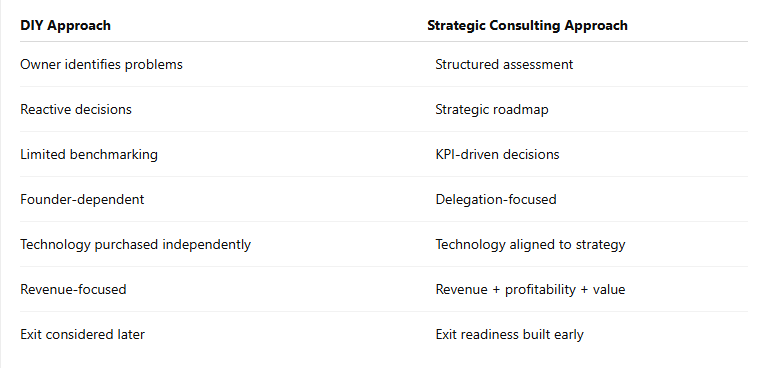
Professional consulting should not make the owner less involved in the vision.
It should make the owner less necessary for routine execution.
How to Choose the Right Medical Practice Consultant in Maryland
Before hiring a consultant, ask these questions.
Does the consultant understand healthcare?
Generic business consulting is not necessarily enough.
Healthcare has unique regulatory, reimbursement, staffing and operational considerations.
Does the consultant understand your specialty?
Behavioral health is different from primary care.
Primary care is different from cardiology.
The business model matters.
Can they measure outcomes?
Ask which KPIs they will track.
Examples include:
- revenue per provider;
- EBITDA margin;
- provider utilization;
- referral conversion;
- patient acquisition cost;
- no-show rate;
- accounts receivable days;
- collection rate;
- staff turnover;
- owner hours.
Can they help reduce founder dependence?
If the owner remains the central operating system, scaling will remain difficult.
Do they understand exit readiness?
Even if you never sell, the principles of exit readiness can improve operational quality.
Medical Practice Consulting Maryland: The 10 Questions Every Owner Should Ask
Before choosing a consulting or management partner, ask:
- What healthcare specialties do you understand?
- How do you measure practice profitability?
- What KPIs will you track?
- How will you identify revenue leakage?
- How will you reduce administrative workload?
- What technology and AI opportunities exist?
- How will you improve management accountability?
- How will you reduce owner dependence?
- How will your work affect enterprise value?
- What does success look like after 90 days, one year and three years?
The answers will tell you far more than a generic sales presentation.
Frequently Asked Questions
1. What does a medical practice consultant do in Maryland?
A medical practice consultant helps physicians and healthcare business owners improve strategy, operations, financial performance, technology, leadership and growth. Depending on the engagement, consulting may also include AI implementation, revenue-cycle optimization, practice valuation preparation and exit planning.
2. What is the difference between a medical practice consultant and a practice management company?
A medical practice consultant typically focuses on strategy, diagnosis, implementation and business improvement. A practice management company may take on ongoing operational functions such as billing, staffing, administration, technology or revenue-cycle management. The appropriate model depends on the practice's size, goals and internal capabilities.
3. What is a behavioral health practice worth?
Behavioral health practice value depends on factors such as adjusted EBITDA, revenue quality, provider retention, payer mix, management depth, owner dependence, growth and risk. There is no universal valuation multiple that applies to every behavioral health business.
4. What are behavioral health practice EBITDA multiples?
Behavioral health EBITDA multiples vary according to practice size, specialty, profitability, scale, growth, payer mix, provider dependence and management infrastructure. Smaller owner-dependent practices generally have different valuation dynamics from larger, diversified platforms. Published market sources should be treated as directional rather than as a substitute for a formal valuation.
5. Should I hire an MSP or medical practice consultant?
It depends on the problem. An MSP is generally focused on IT infrastructure, cybersecurity, cloud systems and technical support. A medical practice consultant focuses on broader business issues such as strategy, operations, profitability, leadership and growth. A growing healthcare organization may benefit from both.
6. When should a healthcare practice begin exit planning?
Ideally, well before the owner expects to sell. Financial normalization, leadership development, process documentation, provider retention and reducing founder dependence can take years. Beginning early provides more time to improve the business before a transaction.
Conclusion
The purpose of medical practice consulting Maryland should not be to create more complexity for healthcare owners.
It should be to create clarity.
Clarity around:
- where the business is today;
- where it needs to go;
- what is preventing growth;
- where revenue is being lost;
- which systems need to change;
- what technology should be implemented;
- how leadership should evolve;
- and what the business could ultimately be worth.
The healthcare practice of the future cannot depend entirely on the physician-owner working harder.
It needs systems.
It needs management.
It needs financial visibility.
It needs technology.
It needs leadership.
And, increasingly, it needs an intentional strategy for AI and automation.
Most importantly, healthcare entrepreneurs need to think beyond the practice itself.
Your practice may be one of your largest assets.
But the ultimate objective should be to turn that asset into financial freedom, business independence and long-term legacy.
That means thinking beyond revenue.
It means thinking about enterprise value.
It means building a business that can operate without you.
It means developing leaders who can make decisions without you.
It means creating systems that produce predictable results.
And it means preparing for your future before circumstances force you to make decisions.
That is the central philosophy behind the NEXT Framework at Your Lifestyle Navigator: Navigate business growth, Elevate wealth, plan your eXit, and Transfer your legacy.
Ready to Build a More Valuable Healthcare Business?
If you are a physician, behavioral health founder, medical practice owner or healthcare entrepreneur who wants to improve growth, operations, AI adoption, profitability or exit readiness, the next step should not be another generic business article.
Start with a strategic conversation about your actual business.
Your Lifestyle Navigator currently offers a complimentary 20–30 minute NEXT Strategy Session focused on practice growth, AI workflows, wealth, exit and legacy priorities.
Book Your Complimentary NEXT Strategy Session
The goal is not simply to build a bigger practice.
The goal is to build a healthcare business that creates wealth, freedom and legacy.