
AI Implementation
The Importance of AI in Healthcare Operations: The Complete Guide

AI in healthcare operations is cutting admin costs, denials, and burnout for US practice owners. See the data, the risks, and how to implement it right.
The Importance of AI in Healthcare Operations: The Complete Guide
You didn't become a healthcare entrepreneur to spend your nights fighting insurance denials, chasing prior authorizations, and rebuilding a staffing schedule that fell apart because two nurses called out. But that's the reality for most owners and administrators running a healthcare agency in the United States right now — and it's exactly why AI in healthcare operations has moved from "innovative pilot project" to survival strategy in the space of about two years.
This guide breaks down what AI in healthcare operations actually means, what it costs, what it saves, what the law requires, and how to bring it into your practice without creating a new HIPAA headache. It's written for physicians, behavioral health founders, and healthcare agency owners across the DMV and nationwide who are tired of generic "AI will transform healthcare" articles and want the operational, financial, and regulatory truth.
What Does AI in Healthcare Operations Mean?
AI in healthcare operations refers to the use of machine learning, generative AI, natural language processing, and predictive analytics to run the non-clinical (and increasingly, semi-clinical) engine of a healthcare business — scheduling, documentation, billing, staffing, prior authorization, denial management, patient communication, and compliance monitoring.
It's distinct from clinical AI, which supports diagnosis and treatment decisions (radiology models, sepsis-prediction algorithms, and similar tools regulated as medical devices). Operational AI, by contrast, lives in the back office and front desk — the part of the business that determines whether a practice is profitable, sustainable, and sane to run. For most independent practices and small-to-midsize healthcare agencies, this is where AI delivers the fastest, most measurable return, because it touches the workflows that consume the most staff hours and generate the most revenue leakage.
Why AI in Healthcare Operations Matters Right Now
Three forces are converging on healthcare agency owners simultaneously: rising labor costs, shrinking reimbursement margins, and a documentation and administrative burden that has grown faster than staffing budgets can absorb. Administrative complexity alone is estimated to add roughly $20 billion a year in avoidable cost to the US healthcare system, largely from inconsistent payer requirements, manual documentation, and billing rework. Practices that keep running these processes by hand aren't just less efficient than AI-enabled competitors — they're absorbing a cost their competitors have already engineered away.
Adoption reflects that urgency. Roughly 80% of hospitals now use AI in at least one clinical or operational function, generative AI tied directly into electronic health record (EHR) systems is used by about 31.5% of US hospitals with another quarter planning adoption within a year, and two in three physicians report using some form of health AI in their practice. This is no longer an early-adopter story. It's the new baseline of competitive healthcare operations in the United States.
The 2026 State of AI Adoption in US Healthcare Operations (By the Numbers)
Healthcare business owners respond to numbers, not hype. Here is where the data actually stands heading into the second half of 2026:
- 75% of physician AI users report the technology has already reduced administrative burden and improved job satisfaction.
- 69% of physician AI users report better patient care and outcomes as a direct result of using AI in their workflow.
- 71% of US acute-care hospitals have integrated predictive AI into their EHR systems, up from 66% a year earlier.
- Predictive AI use for billing automation jumped from 36% to 61% of hospitals in a single year, and scheduling automation grew from 51% to 67%.
- Ambient AI documentation is now deployed in roughly 62.6% of Epic-based hospitals, up from near zero two years prior.
- AI-assisted documentation has been linked to a burnout decline from 51.9% to 38.8% among short-term users, with individual health systems reporting even sharper drops — Mass General Brigham recorded a 40% relative reduction in clinician burnout, and MultiCare Health System reported a 63% reduction.
- AI companies captured 55% of total US health tech funding in 2025, signaling where investors — and increasingly payers — expect the next decade of healthcare infrastructure to be built.
The pattern across every one of these figures is the same: the earliest and clearest wins from AI in healthcare operations are not in diagnostics. They're in the administrative and financial machinery that determines whether a healthcare agency survives its own overhead.
Operational AI in Healthcare: Examples You Can Actually Use
"AI in healthcare operations" is a broad phrase. Below are the specific, deployable applications that US healthcare agencies are using right now, organized by the part of the business each one touches.
1. Ambient AI Documentation and Scribes
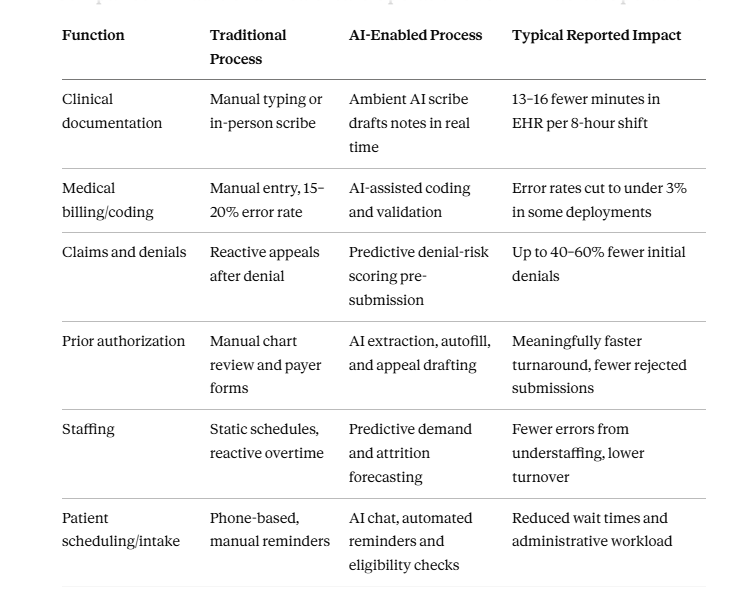
AI tools like Epic's Art for Clinicians, DAX Copilot, Abridge, Suki, and Freed passively listen to a patient encounter and draft a structured clinical note for physician review. More than 80% of physicians already use some form of ambient scribe, and independent studies across five academic medical centers found adopters spent about 13 fewer minutes in the EHR and 16 fewer minutes on documentation per eight hours of patient care.
2. AI for Revenue Cycle Management in Healthcare
This is where operational AI in healthcare operations tends to pay for itself fastest. AI models predict which claims are likely to be denied before submission, flag missing modifiers and incorrect CPT codes, auto-generate appeal letters, and reconcile remittance data against contracted payer rates. One hospital using denial-prediction tools saw a 19% drop in denial rates within six months; broader industry data shows AI reducing billing errors by up to 75–85% and cutting initial claim denial rates by 40–60%.
3. AI Solutions for Medical Billing Errors
Manual coding error rates commonly run 15–20%. AI-assisted coding platforms have pushed that down to under 3% in some deployments, while achieving 95–98% first-pass coding accuracy. For an agency losing tens of thousands of dollars a year to rework and underpayment, this single use case can fund the rest of an AI operations rollout.
4. Generative AI for Prior Authorization
Prior authorization remains one of the most despised administrative processes in US healthcare — and one of the most expensive, estimated to influence up to 5% of total medical and drug spending. Generative AI tools now read the clinical record, match it against payer-specific medical necessity criteria, auto-populate the PA form with supporting citations, and route it for provider sign-off inside the EHR. Epic's 2026 roadmap includes real-time prior authorization automation built directly into its platform, reflecting how central this use case has become.
5. Predictive Analytics for Hospital and Clinic Staffing
Predictive staffing models forecast patient volume based on historical admissions, seasonal patterns, and local trends, then recommend staffing levels before a shortage happens. Health systems using AI-driven staffing have reported meaningful reductions in medical errors linked to better nurse-to-patient ratios, faster emergency department throughput, and double-digit reductions in avoidable staff turnover through earlier attrition warnings.
6. AI-Powered Patient Engagement and Scheduling
Chatbots and AI-driven outreach tools handle appointment reminders, intake forms, eligibility checks, and routine patient questions — cutting wait times and administrative workload while freeing front-desk staff for higher-value interactions.
Healthcare Workflow Automation Software: What Belongs on Your Shortlist
Not every healthcare workflow automation software platform is right for every agency. Before you buy anything, map your shortlist against these five categories:
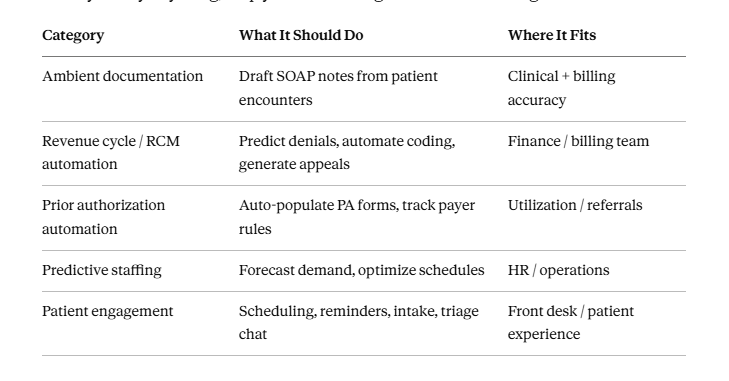
A practice with five providers does not need the same stack as a 40-provider multi-site agency. The mistake most owners make is buying the flashiest tool (usually a scribe) first and never touching the revenue cycle or staffing side, where the largest and most consistent ROI actually lives.
Benefits of AI in Healthcare Operations
The advantages of AI in healthcare operations compound across four areas that matter most to a practice owner's bottom line and sanity:
- Lower administrative cost. Automating eligibility checks, coding, and denial management directly reduces labor hours spent on rework.
- Faster revenue realization. Fewer denials and faster prior authorizations mean cash reaches the practice sooner.
- Reduced clinician burnout. Less time on documentation translates into more time with patients and, in multiple studies, measurably lower burnout scores.
- Better staffing precision. Predictive models reduce both costly overstaffing and dangerous understaffing.
- Improved patient experience. Shorter wait times, faster scheduling, and more present clinicians during visits.
- Scalability without proportional headcount growth. AI absorbs volume spikes that would otherwise require new hires.
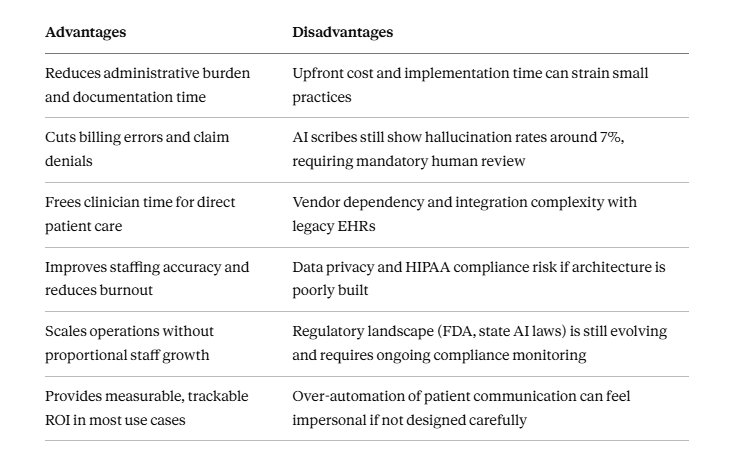
Advantages and Disadvantages of AI in Healthcare Operations
No honest guide to this topic ignores the tradeoffs. Here's the balanced view your healthcare agency needs before signing any AI vendor contract.
Comparison: Traditional Healthcare Operations vs. AI-Enabled Operations
Regulations for AI in Medical Operations: What US Healthcare Agencies Must Know
This is the section most competing content skips — and it's the one that can end a healthcare agency if ignored.
FDA Oversight of AI-Enabled Tools
The FDA has now cleared or authorized more than 1,350 AI-enabled medical devices, nearly double the 2022 total. For tools that touch diagnosis or treatment decisions, the FDA's Total Product Lifecycle (TPLC) framework and Predetermined Change Control Plans (PCCPs) — formalized through 2025 final guidance — govern how AI algorithms can be updated post-market without triggering a new submission. PCCPs must remain focused, risk-based, evidence-based, transparent, and lifecycle-oriented. If your practice uses AI clinical decision support (not just operational automation), your vendor's PCCP status is worth verifying directly.
What the EU AI Act Means for US Operators
The EU AI Act classifies most healthcare AI as "high-risk," requiring risk management systems, human oversight, and conformity assessments — but it only directly applies to organizations operating in or serving patients in the EU. US-based healthcare agencies generally aren't bound by it. What does matter for US operators is the direction of travel it represents: regulators globally are converging on transparency, human review, and documented risk management as baseline expectations, and US state legislatures are already following that pattern independently.
HIPAA and AI: The RAG Architecture Risk
Many AI documentation and chatbot tools rely on Retrieval-Augmented Generation (RAG) — pulling from a database of patient records to generate accurate, grounded responses. This creates HIPAA exposure most vendors don't disclose clearly:
- Embedding inversion: vector embeddings created from patient notes can, under certain conditions, be reverse-engineered to recover the original text — meaning those embeddings must be treated and secured as Protected Health Information (PHI).
- Prompt injection: a clinical AI tool with live EHR access can be manipulated through crafted inputs to expose data it shouldn't return.
- Access-control failures: without proper isolation, a semantic search can return one patient's notes in response to a query about another patient.
The Office for Civil Rights resolved 21 HIPAA enforcement cases in 2025 alone, with the majority tied to risk-analysis and risk-management failures — and AI-related incidents are now explicitly part of that enforcement focus. Before deploying any RAG-based tool, your agency needs a signed Business Associate Agreement (BAA), documented de-identification methodology, encrypted and access-controlled embeddings, and a full audit trail of every AI interaction with PHI.
State-Level AI Laws Are Already Here
California's AB 3030 (effective 2025) requires a disclaimer whenever generative AI produces patient-facing clinical communication without prior review by a licensed provider. Illinois' HB 1806 bans AI from being used for direct therapy or independent clinical decision-making in counseling contexts. More states are expected to follow in 2026–2027. If your agency operates in multiple states, this is no longer a single compliance checklist — it's a moving target that needs ongoing legal review, not a one-time policy.
Reducing Administrative Burden in Healthcare With AI: The Human Cost Nobody Puts in the Pitch Deck
Every statistic in this guide represents something more personal for the people running healthcare agencies: the 9 p.m. charting session after a full day of patients, the front-desk staffer fielding the same insurance call for the third time, the owner who became a clinician to help people and now spends half their week fighting claim denials instead. Administrative burden isn't an abstract inefficiency — it's the reason talented clinicians leave the field, the reason margins erode even when patient volume is strong, and the reason many healthcare entrepreneurs feel like they're managing a bureaucracy instead of running a mission. Reducing administrative burden in healthcare with AI isn't just an efficiency project. Done right, it's what makes it possible to keep the practice, and the people in it, sustainable.
Common Mistakes Healthcare Agencies Make When Adopting AI Operations
- Buying the shiny tool first. Scribes get attention, but revenue cycle and prior authorization automation often deliver faster, larger ROI.
- Skipping the HIPAA risk assessment. A vendor's marketing claim of being "HIPAA-ready" is not the same as a signed BAA and a documented compliance architecture.
- No pilot phase. Rolling out AI practice-wide before testing with 2–3 vendors on a small group of clinicians almost always produces avoidable friction and wasted spend.
- Treating AI as "set and forget." Every AI scribe still requires physician review; every predictive model needs ongoing performance monitoring.
- No change management for staff. Billing and front-desk teams need training and a clear understanding of how their roles evolve — not just software access.
- Ignoring state-specific AI disclosure laws when operating across multiple states.
How Healthcare Practice Owners Should Approach AI: The NEXT Framework
At Your Lifestyle Navigator, we don't treat AI in healthcare operations as an isolated IT project — because for a healthcare agency owner, it never is. It's a business growth decision, a wealth decision, and eventually an exit-value decision, all at once. That's why we built the NEXT Framework around exactly this kind of integrated thinking:
- Navigate — We help you identify which operational AI tools (documentation, RCM, staffing, prior authorization) will move the needle fastest for your specific practice size, specialty, and payer mix, and build the systems and workflows to implement them without disrupting patient care.
- Elevate — Every dollar AI recovers from denied claims, reduced overtime, or reclaimed clinician hours is a dollar that can be redirected into your personal wealth strategy, not absorbed by operational drag.
- eXit — A practice with modern, AI-enabled operations, clean financials, and documented compliance is a fundamentally more valuable and more sellable asset than one still running on manual processes.
- Transfer — Efficient, well-documented operations make succession and legacy planning dramatically easier for the next owner or the next generation of your family.
This is the difference between hiring a generic software vendor and working with a healthcare consultant who understands both the clinical and the financial sides of your business.
Why Work With a Healthcare Management Consulting Partner Instead of Going It Alone
Healthcare agency owners considering AI adoption typically face three paths: do nothing and keep absorbing administrative cost, buy point-solution software and hope it integrates, or work with a healthcare management consulting partner who builds the strategy around your whole business. The first path is the most expensive by default — every year of delay compounds lost revenue and clinician burnout. The second path frequently fails because tools get purchased in isolation without a governance plan, a compliance review, or staff buy-in.
Your Lifestyle Navigator exists for the third path. Founded by John S. Smith Jr., RN, BSN — a clinician-turned-entrepreneur who built and scaled his own healthcare business before founding Prestige Healthcare Resources Inc. — Your Lifestyle Navigator understands the healthcare entrepreneur's journey from the inside: the payroll pressure, the regulatory complexity, the reimbursement squeeze, and the isolation of making high-stakes decisions without a team of specialists behind you.
Frequently Asked Questions
What is the average ROI of implementing ambient AI scribes in a mid-sized clinic? Reported ROI varies by study design, but the pattern is consistent: ambient scribes cost roughly $99–$1,000 per provider per month, compared to $45,000–$65,000 a year for a human scribe, with most practices reaching ROI within 3–12 months. Time studies across five academic medical centers found 13–16 minutes saved per eight-hour shift, while a five-site study found an average $167 monthly revenue increase per clinician, and a UCSF analysis linked scribe access to a 5.8% increase in weekly RVUs (roughly $3,000 per physician per year at current Medicare rates).
How do hospitals use generative AI to automate prior authorizations? Generative AI reads the patient's clinical record, extracts evidence relevant to a specific payer's medical necessity criteria, auto-fills the payer's PA form with supporting citations, and routes it to the provider for review before submission. When a denial happens, the same systems can draft an evidence-based appeal letter automatically. Epic's platform has moved toward real-time prior authorization built directly into its EHR workflow as of 2026.
What does the EU AI Act or US FDA framework mean for operational AI? The EU AI Act classifies most healthcare AI as high-risk and applies primarily to organizations operating in the EU. US healthcare agencies are instead governed by the FDA's framework for AI-enabled medical devices (relevant mainly for clinical decision-support tools, not pure operational software), which uses Predetermined Change Control Plans and a Total Product Lifecycle approach to manage ongoing algorithm updates. Purely operational tools — billing automation, scheduling, ambient documentation — generally fall outside FDA device regulation but remain fully subject to HIPAA and applicable state AI laws.
How does Epic EHR integrate with AI documentation tools? Epic offers its own ambient scribe (Art for Clinicians) alongside deep integrations with third-party tools like DAX Copilot and Abridge. As of mid-2025, roughly 62.6% of Epic hospitals had deployed ambient AI documentation. Beyond scribing, Epic's AI tools extend into billing (a coding and denial-appeal copilot), patient scheduling assistance, and real-time prior authorization, all built into the same clinical workflow clinicians already use.
What are the HIPAA compliance risks of using RAG architectures for patient notes? The main risks are embedding inversion (recovering original patient text from stored vector embeddings), prompt injection (manipulating an AI tool with EHR access into exposing data it shouldn't), and inadequate access control (returning one patient's information in response to a query about another). Mitigation requires treating embeddings as PHI, encrypting and access-controlling the retrieval database, signing a BAA with the vendor, and maintaining a full audit trail of AI-PHI interactions.
Can AI reduce clinical burnout in US healthcare operations? Yes. Multiple health systems have reported measurable reductions: Mass General Brigham recorded a 40% relative reduction in clinician burnout after ambient scribe adoption, MultiCare Health System reported a 63% reduction alongside a 64% improvement in work-life balance, and broader survey data shows burnout rates dropping from roughly 52% to 39% among short-term AI documentation users. The mechanism is straightforward: less after-hours "pajama time" charting means more time for patients, family, and rest.
Is AI in healthcare operations HIPAA compliant by default? No. Compliance depends entirely on the vendor's architecture and your agency's implementation — specifically a signed BAA, encryption, access controls, and audit logging. "HIPAA-ready" marketing language is not the same as documented HIPAA compliance.
Will AI replace healthcare administrative and billing staff? The clearer trend is role transformation, not elimination. As routine data entry and claim scrubbing get automated, billing and administrative staff shift toward managing complex cases, appeals, payer relationships, and oversight of AI-generated outputs — work that still requires human judgment.
Conclusion: AI in Healthcare Operations Is No Longer Optional
AI in healthcare operations has moved past the hype cycle and into measurable, auditable business impact — fewer denied claims, faster prior authorizations, lower documentation burden, better staffing precision, and, for many clinicians, a real reduction in burnout. But the agencies capturing that value aren't the ones that bought a scribe tool and called it done. They're the ones that treated AI adoption as a strategic, compliance-aware business decision — one connected to their broader growth, wealth, and exit goals, not an isolated software purchase.
If you're a healthcare practitioner or agency owner ready to move from administrative overwhelm to a scalable, AI-enabled operation — without gambling your compliance or your sanity on the wrong vendor — that's exactly what the NEXT Framework was built for.
Book your complimentary NEXT Strategy Session with Your Lifestyle Navigator today and get a clear, personalized roadmap for implementing AI in healthcare operations the right way — for your practice, your patients, and the life you're actually building all of this for.
Get in touch with us on our social media platforms for more: