
Exit Strategy
Preparing Behavioral Healthcare Practice For Sale

Preparing behavioral healthcare practice for sale in 2026? Learn valuation multiples, compliance must-haves, and how to maximize your exit with Your Lifestyle Navigator™’s NEXT Framework™.
Preparing Behavioral Healthcare Practice For Sale
Preparing behavioral healthcare practice for sale is one of the most strategic decisions a practice owner can make—and timing, preparation, and positioning determine whether you exit at a premium multiple or settle for a discount. In 2026, behavioral health remains one of the hottest M&A sectors in the United States, with deal volume up 42% in 2025 and over 100 publicly announced transactions, yet buyers are increasingly selective, rewarding platform-ready businesses while penalizing owner-dependent practices. This guide walks you through exactly what buyers evaluate, how to maximize your valuation, which compliance and regulatory issues matter most, and how to position your practice so it stands out in a crowded, competitive market.
What Does “Preparing Behavioral Healthcare Practice For Sale” Mean?
Preparing behavioral healthcare practice for sale means systematically building your practice so it looks, operates, and performs like an acquisition-ready platform—well before you ever talk to a buyer. It is not about cleaning up your books in the six months before going to market. It is about multi-year work: normalizing financials, reducing founder-clinician dependency, documenting clinical protocols, diversifying payer mix, stabilizing telehealth, and creating a management layer that can run the business without you.
In practical terms, preparation includes:
- Financial readiness: 3–5 years of clean P&L statements, normalized EBITDA with documented add-backs, revenue broken out by payer and service line, and accrual-based accounting.
- Operational depth: A clinical director, billing lead, and operations manager with real authority—not just titles that defer to the founder on every decision.
- Compliance posture: HIPAA security risk assessments, 42 CFR Part 2 consent forms (if you treat SUD), state facility licenses, accreditation (CARF or Joint Commission), and clinician licensure verification for every provider.
- Growth narrative: Documented, operationally grounded expansion opportunities—underserved geographies, untapped service lines, or technology-enabled capacity that a buyer can underwrite.
Why Behavioral Health Is a Prime Acquisition Target in 2026
Behavioral health M&A has surged because demand for mental health, substance use, and integrated behavioral health services vastly exceeds the supply of licensed clinicians. Private equity platforms, hospital systems, and payers are all competing for scalable, well-run practices that can absorb capital and grow without rebuilding the foundation first.
Key market dynamics:
- Fragmentation: The majority of behavioral health revenue in the U.S. comes from small and mid-sized independent practices—exactly the type of business PE platforms want to consolidate.
- Policy tailwinds: Insurance parity laws, telehealth adoption, and reduced stigma have expanded demand, while Medicaid and commercial payers are building provider networks to control cost and access.
- Valuation premium: Outpatient mental health and ABA platforms command 10–14× EBITDA at the platform level, while smaller add-ons trade at 4–8×.
What Buyers Actually Evaluate: The Three Core Questions
Sophisticated buyers—private equity firms, health systems, and strategic acquirers—evaluate your practice against three core questions.
1. Is This Business Predictable?
Predictability comes from the revenue cycle. Buyers want to model future cash flows confidently, so they scrutinize:
- Payer mix stability: What percentage of revenue comes from commercial insurance vs. Medicaid vs. self-pay?
- Clean claim rate and days in AR: High denials or aged receivables signal billing problems that kill deals.
- Revenue concentration: Does the top payer represent 40%+ of collections, creating single-point-of-failure risk?
2. Can This Business Perform Without the Founder?
This is where most behavioral health practices fall short. When the founder is the primary clinical supervisor, key referral relationship holder, and operational decision-maker, a buyer is not acquiring a business—they are acquiring a temporary arrangement that unwinds the moment the founder exits.
Leadership depth, documented clinical protocols, operational systems that function without founder oversight, and a management team with genuine authority are all proxy signals for whether performance survives the transition.
3. Where Is the Growth?
A buyer is not just paying for what your practice earns today. They are paying for what they believe they can build from the asset you are giving them. A practice with documented, unrealized growth opportunities—an underserved geography, an untapped service line, a referral network that could be systematized, a technology implementation that would expand capacity without adding proportional headcount—is worth more than the same practice with no articulated path forward.
Building Financial Visibility Before Due Diligence
The first practical step in preparing behavioral healthcare practice for sale is getting your financial story clean enough to tell confidently—before a buyer asks.
This means more than having an accountant who can produce tidy tax returns. It means being able to answer, without hesitation and with supporting data:
- What is your EBITDA, and what add-backs are legitimate?
- What does your revenue look like by payer, by service line, and by provider?
- What is your margin by service line, and where are the inefficiencies that a buyer would identify as margin expansion opportunities?
- What are your days in accounts receivable, and how have they trended over the last three years?
Most behavioral health practices cannot answer these questions precisely because the financial infrastructure was not built for that level of visibility. Revenue cycle reporting is fragmented. Service-line profitability is buried in blended financials. Add-backs are not documented in a way that survives a sophisticated buyer’s scrutiny.
Correcting this takes time—which is exactly why starting two to three years before you plan to go to market is not excessive. It is appropriate. The financial story you tell in an acquisition is built over years, not assembled in weeks.
Reducing Founder Dependence: The Structural Work
The single most common reason behavioral health practice acquisitions close below the seller’s expectations is founder dependence—and the single most common reason they do not close at all is that the buyer could not get comfortable with what happens to the business after the founder walks out.
Reducing founder dependence is structural work. It is not about working less. It is about deliberately rebuilding the infrastructure of the business so that performance is generated by systems and people, not by your personal involvement.
Concretely, this means several things:
- Document clinical supervision protocols so that quality standards are codifiable and teachable, not carried entirely in the founder’s clinical judgment.
- Build a management layer—a clinical director, an operations manager, a billing lead—with genuine authority and accountability, not as titles that defer to the founder on every real decision.
- Create referral development systems so that referral relationships are owned by the practice, not by the founder’s personal network.
- Implement technology infrastructure—AI-enabled intake, automated billing, scalable scheduling systems—that allows the practice to handle volume growth without requiring proportional founder oversight.
The timeline for this work matters. Leadership development and cultural change cannot be manufactured quickly enough to survive due diligence scrutiny if they are started after a buyer appears. They need to be genuinely embedded—visible in org charts, confirmed in staff interviews, documented in performance reviews—to hold up under examination.
Payer Mix and Reimbursement: The Most Important Valuation Driver
No valuation factor drives the spread between behavioral health practice multiples more than payer mix. The difference between a practice that has invested in commercial insurance contracting and one that has grown primarily through Medicaid referrals can be 3–4 EBITDA multiple turns, representing millions of dollars in enterprise value at typical practice sizes.
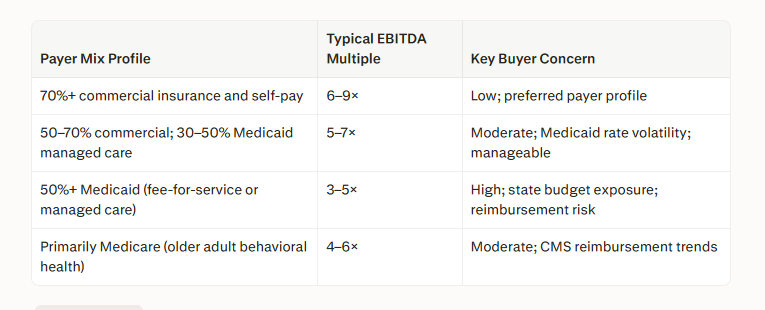
Reimbursement rate trends for the trailing 24 months are as important as the current payer mix. A practice that has been successfully renegotiating commercial payer rates upward (demonstrating network adequacy leverage) is worth more than one accepting whatever the carrier offers. Pull the rate history for each major commercial payer—if rates have increased in line with inflation or above, document it. If rates have been flat for 5+ years, buyers will model that as a margin compression risk.
Licensed Clinical Staff Retention: The Primary Post-Close Risk
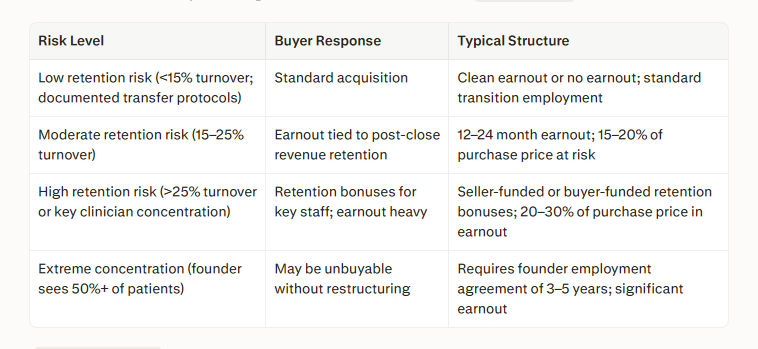
In behavioral health, the revenue walks in the door with the clinician. A licensed therapist, psychologist, or counselor typically carries a caseload of 20–35 active clients; when that clinician leaves, the majority of their clients will either follow them to their new employer or terminate services. This dynamic makes staff retention the central risk factor in behavioral health M&A, and the central focus of buyer deal structuring.
The staff retention analysis begins with turnover data. Buyers want trailing 24-month clinician turnover rates, the reason for departure (voluntary vs. involuntary), and what happened to the departing clinician’s caseload (transferred to another clinician, lost to attrition, or followed the clinician). A practice with less than 15% annual licensed clinician turnover and documented protocols for caseload transfer demonstrates operational stability. A practice with 30%+ turnover or no caseload transfer protocol is presenting a significant retention risk that buyers will price into the deal structure.
Read more blogs: How to Automate Healthcare Billing Without Replacing Staff
Regulatory and Compliance Requirements Unique to Behavioral Health
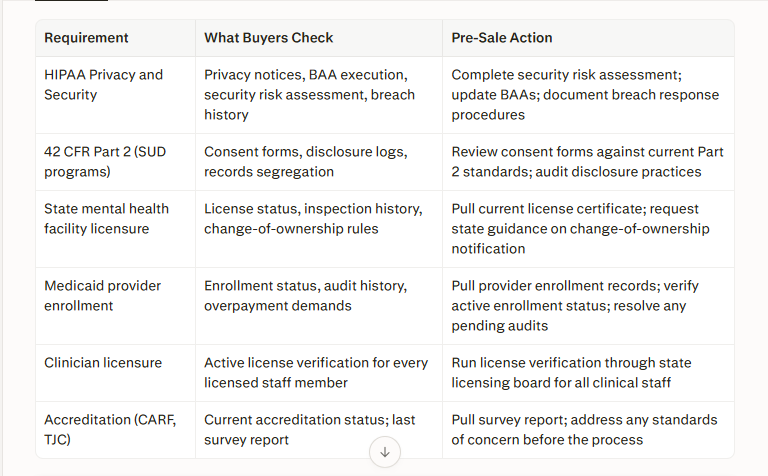
Behavioral health has a regulatory compliance layer that exceeds most other healthcare settings, primarily because the sensitive nature of mental health and substance use information requires protections beyond standard HIPAA. Sellers who have not proactively addressed compliance will encounter these issues during diligence, with buyers holding price leverage.
42 CFR Part 2 (Substance Use Disorder Programs)
Substance use disorder treatment programs operate under 42 CFR Part 2 (Confidentiality of Substance Use Disorder Patient Records), a federal regulation that prohibits disclosure of SUD patient records without explicit written patient consent, even to other treating providers, law enforcement, or family members. This is more restrictive than HIPAA, which permits disclosure for treatment, payment, and operations without explicit consent. Practices that operate SUD programs alongside general mental health services must maintain separate records systems or rigorous consent tracking to avoid Part 2 violations. Buyers diligence Part 2 compliance specifically—violations carry civil and criminal penalties.
State Licensure and Change-of-Ownership Rules
State-specific licensure transfer is one of the most frequent closing delays in behavioral health M&A. Some states (California, New York, Texas) require a new licensure application for behavioral health facilities when ownership changes—a process that can take 60–120 days. Sellers in these states must identify the licensure transfer requirement before LOI and build the timeline into the closing conditions. Buyers who discover a required re-licensure application after LOI signing will either extend the timeline (reducing certainty) or require the seller to bear the risk of continued operations under the old license while the new application is pending.
Compliance Checklist
Telling a Growth Story That Buyers Believe
The final component of acquisition readiness is constructing a forward-looking narrative that a buyer can underwrite with confidence. This is not about projections. Sophisticated buyers discount projections aggressively, particularly from founder-operators who have an obvious incentive to paint an optimistic picture. What moves the needle is documented, specific, operationally grounded growth opportunities—the kind that a buyer can look at and say, “Yes, I can see how to get there from here.”
Service line expansion opportunities are one of the most credible. If your practice has demonstrated clinical competency in a specialty area—intensive outpatient, medication-assisted treatment, adolescent services—and the market data supports unmet demand in your geography, that is a documentable growth lever. A buyer acquiring your practice already knows how to stand up that service line because they have done it elsewhere in their portfolio.
Technology-enabled capacity expansion is another. A practice that has implemented AI-driven intake and scheduling but has not yet maximized its capacity utilization is, from a buyer’s perspective, a margin improvement opportunity that is already de-risked by the infrastructure investment you have already made.
The goal is to give a buyer a credible answer to the question: “What does this practice look like at two times its current revenue?” If you can answer that question specifically, operationally, and with evidence, you are not just selling a practice. You are selling a platform. The difference in valuation between those two things is not incremental. It is the difference between a transaction that changes your financial life and one that simply closes a chapter.
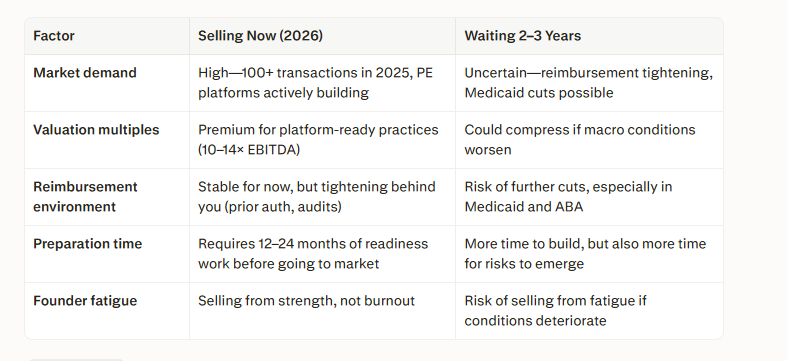
Advantages and Disadvantages of Selling Now vs. Waiting
Read more Blogs: Moving From Practitioner to CEO: A Guide for Healthcare Founders
The NEXT Framework™: How Your Lifestyle Navigator™ Prepares You for Exit
At Your Lifestyle Navigator™, the Exit Strategy tier of the NEXT Framework™ begins with exactly this kind of structured readiness assessment: where your financials stand today, where founder dependence lives in your org chart, and what the gap is between your current operations and the acquisition-ready platform a serious buyer would want to own.
We work with behavioral health and healthcare founders generating between $3M and $20M in revenue across the DMV region and nationally to build acquisition-ready enterprises through systematic preparation, operational discipline, and AI-enabled execution. Our approach is not about selling you a service—it is about giving you an honest assessment of where your practice stands on the acquisition readiness spectrum and what the work actually involves.
What we do:
- Financial visibility: We help you normalize EBITDA, document add-backs, and break out revenue by payer and service line so your financial story is clean and defensible.glacierlakepartners+2
- Founder independence: We work with you to build a management layer, document clinical protocols, and implement technology infrastructure so the practice can perform without you at the center of every decision.
- Compliance readiness: We ensure your HIPAA, 42 CFR Part 2, state licensure, and accreditation files are current and audit-ready before a buyer ever asks.
- Growth narrative: We help you articulate specific, operationally grounded expansion opportunities that a buyer can underwrite with confidence.
If you are a behavioral health or healthcare founder generating between three and twenty million dollars in revenue and you want an honest assessment of where your practice stands on the acquisition readiness spectrum, book a complimentary AI Readiness & Strategy Session with Dr John Smith Jnr. The conversation is confidential, and you will leave with a clear picture of what the work actually involves.
Frequently Asked Questions
1. How much is my behavioral health practice worth in 2026?
Solo or small outpatient therapy/psychiatry practices typically sell for 3× to 6× SDE/EBITDA, because revenue is clinician-dependent. Multi-site, multi-clinician behavioral health groups with a management layer (roughly $1M–$5M EBITDA) sell for 6× to 8× EBITDA. Larger platforms and high-demand subsegments (psychiatry-heavy groups, IOP/PHP operators, integrated behavioral health, $5M+ EBITDA) reach 12× to 15×+ EBITDA. The biggest multiple drivers are scale, payer mix and billing quality, clinician recruitment/retention, and a management layer independent of the founding clinician.
2. What makes a behavioral health practice more valuable?
Scale (more sites, more clinicians beyond the owner, more EBITDA, valued at a higher multiple per dollar); payer mix and revenue quality (in-network commercial with strong rates, stable Medicaid contracts, clean billing with low denials and AR aging); a clinician recruitment engine and low turnover (clinician supply is the binding constraint, so a practice that can hire and keep clinicians is a growth platform); a management/operations layer (intake, scheduling, billing, credentialing) that runs without the founding clinician; a defensible corporate structure; a durable telehealth model; and clean accrual financials that normalize owner comp and break out the payer mix. Reducing founder-clinician dependency is the single biggest lever.
3. How long does it take to prepare a behavioral health practice for sale?
Most M&A advisors working in behavioral health recommend beginning financial preparation at least twelve to twenty-four months before a planned transaction. Leadership development, clinical protocol documentation, and technology implementation cannot be manufactured quickly enough to survive due diligence scrutiny if they are started after a buyer appears. They need to be genuinely embedded—visible in org charts, confirmed in staff interviews, documented in performance reviews—to hold up under examination.
4. What compliance issues kill behavioral health deals in diligence?
Billing and revenue-cycle problems (high denials, aged AR, credentialing gaps, coding that does not hold up); compliance flags (documentation deficiencies, billing-for-services-not-rendered exposure, telehealth-rule issues); founder-clinician dependency (the revenue is the owner’s caseload and walks with them); clinician turnover or a thin/aging clinician roster with no recruiting pipeline; worker-classification exposure from a pure-1099 clinician model; payer concentration or over-reliance on self-pay/out-of-network revenue that buyers cannot model; telehealth volume that is a pandemic artifact, not a durable model; and sloppy financials that do not normalize owner comp or break out the payer mix.
5. Do I need a broker to sell my behavioral health practice?
For a solo or small practice, a healthcare-focused business broker can work but charges 8–15% commissions. For multi-site, multi-clinician groups, a buyer-paid sell-side advisor that has relationships with the PE-backed behavioral health platforms, health systems, and payers usually produces better outcomes—higher multiples, better-matched buyers, faster close, no seller fee (the buyer pays at closing). Some sellers sell directly to a known platform with just healthcare transactional counsel, but a competitive process almost always lifts the price.
Conclusion
You built this practice from the ground up. You carried the risk, made the hard calls, and showed up for your patients every single day. Now, as you think about what comes next, you deserve an exit that honors that work—not a discount because you waited too long to prepare.
The window for premium exits in behavioral health is open and active. But it will not stay open indefinitely. The practices that are ready when serious buyers come looking will transact at multiples that reflect the opportunity. The practices that are not will either accept a discount or miss the window entirely.
If you are a behavioral health or healthcare founder generating between three and twenty million dollars in revenue and you want an honest assessment of where your practice stands on the acquisition readiness spectrum, book a complimentary AI Readiness & Strategy Session. The conversation is confidential, and you will leave with a clear picture of what the work actually involves.
Book Your AI Readiness & Strategy Session
Get in touch with us on our social media platforms for more: