
Lifestyle
Moving From A Healthcare Practitioner To A CEO: The Complete Leadership Roadmap
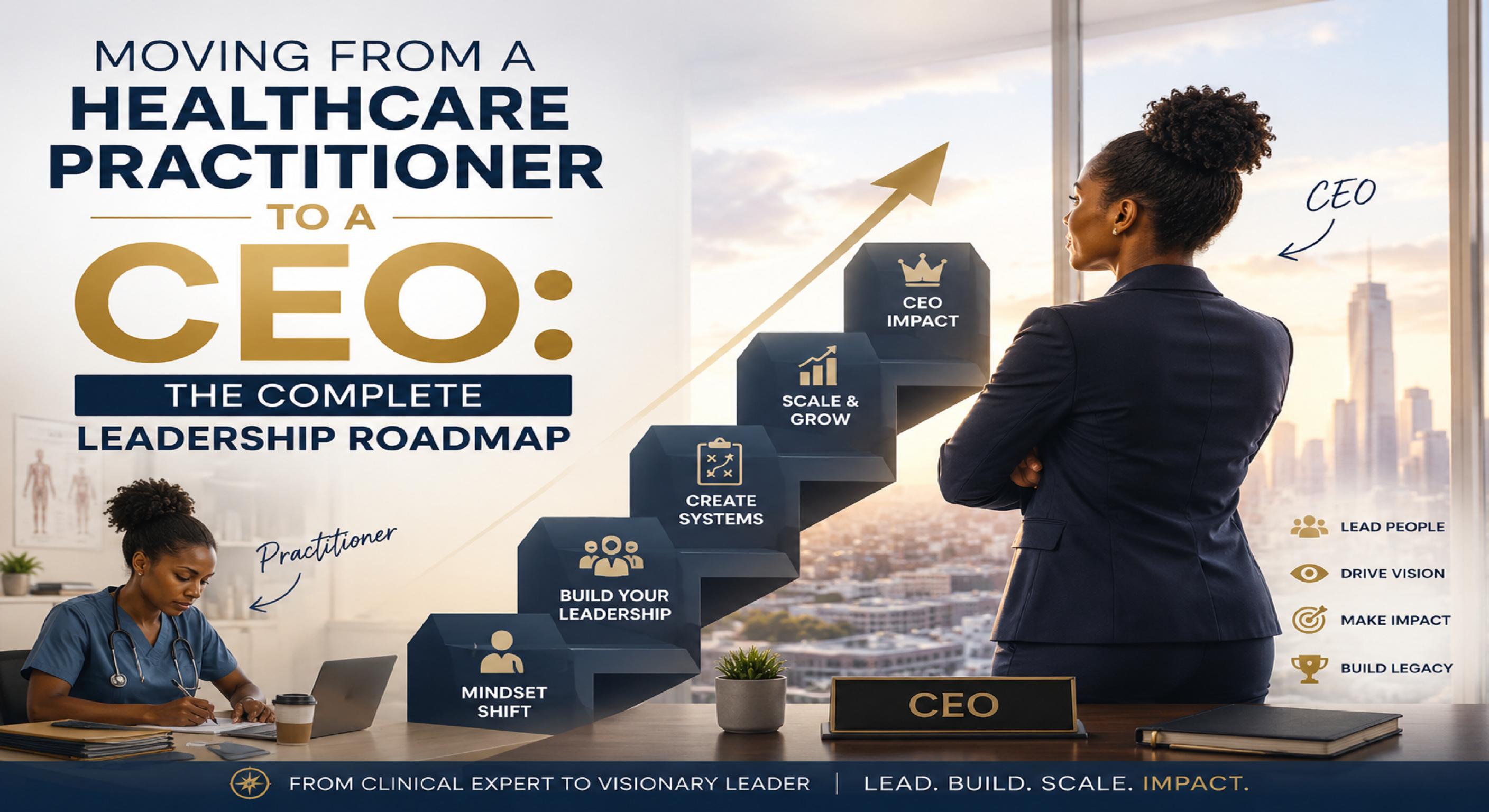
Moving from a healthcare practitioner to a CEO? Get the real US path, skills, salary data, and legal steps to lead your practice with the NEXT Framework.
There is a moment most healthcare founders recognize the instant they hear it described. You built something real. Revenue is coming in. Patients are being served. Staff are showing up. On paper, it looks like success. And yet you are exhausted in a way that vacation does not fix. Moving from a healthcare practitioner to a CEO is the transition that closes that gap — and it is one of the least understood career shifts in American medicine, nursing, and behavioral health.
Every decision still funnels back to you. Every operational problem waits for your attention before it moves forward. You are, in effect, the highest-paid employee in a business you technically own. This guide breaks down exactly what that transition requires — the mindset, the skills, the credentials, the legal landscape, the compensation reality, and the step-by-step roadmap — so you can stop being the bottleneck in your own organization and start leading it like the executive you were always meant to become.
What Does It Mean to Move From a Healthcare Practitioner to a CEO?
Moving from a healthcare practitioner to a CEO means shifting from being the person who delivers clinical or operational work to being the person who builds and leads the system that delivers it. A healthcare practitioner — a physician, nurse, therapist, dentist, chiropractor, or allied health professional — is trained and compensated for direct patient care. A healthcare CEO is trained and compensated for strategy, capital allocation, culture, financial performance, and organizational direction.
This is not simply a title change. It is an identity shift. Physician executives, nurse executives, and practice-owner CEOs across the United States describe it the same way: the credibility you built through clinical excellence does not automatically transfer to boardroom credibility. You have to earn a second kind of authority — business authority — on top of the clinical authority you already hold.
Search behavior confirms how common this crossroads has become. Practitioners across the U.S. are actively asking: how to become a hospital CEO, what are the steps to transition from healthcare to CEO, what skills does a healthcare CEO need, and can a nurse become a hospital CEO. This guide answers all of it in one place.
Why This Transition Matters Right Now
The urgency behind the practitioner-to-CEO conversation is not anecdotal — it is structural, and the data backs it up.
- Physician-led hospitals have declined sharply over the last century. In the 1930s, physicians led the overwhelming majority of U.S. hospitals. Today, only a small fraction of hospital CEOs — roughly 5% — hold a medical degree, even though physician-led hospitals consistently rank higher in quality outcomes.
- The average tenure of a healthcare CEO in the U.S. is only around 7 to 8 years, which means the executive suite is turning over constantly and creating real opportunity for clinicians who are prepared to step in.
- Clinician burnout is now one of the top three reported reasons healthcare practitioners either leave clinical practice or actively pursue a leadership or ownership track instead.
- Private equity, health systems, and physician groups are actively recruiting clinicians into executive and medical-director tracks because clinical fluency plus business fluency is rare and valuable.
In other words: the market wants more clinicians in the C-suite, not fewer. The barrier isn't opportunity — it's preparation.
The Practitioner-to-CEO Trap (And Why It's Not a Time Management Problem)
Most healthcare founders are running four jobs simultaneously. They are the chief clinical officer, responsible for quality and outcomes. They are the head of operations, solving staffing shortages and billing backlogs. They are the chief revenue officer, managing referral relationships and payer contracts. And in whatever hours remain, they are supposed to be the visionary — setting strategy and preparing the business for what comes next.
None of this is sustainable, and more importantly, none of it is actually the job of a CEO. A CEO's job is not to do the work. It is to build the machine that does the work, and then lead the people running that machine — strategy, capital allocation, culture, and the external relationships nobody else can own. Everything else is a delegation waiting to happen.
This is the practitioner-to-CEO trap, and it is not a time management problem. It is an identity problem. The practitioner identity runs deep — you spent years training to be excellent at clinical work, and your credibility, confidence, and sense of purpose are tied to that expertise. Stepping away from it, even partially, feels like a loss rather than a promotion. It isn't. It's the prerequisite for a scalable business, personal financial freedom, and eventually an exit that rewards everything you built.
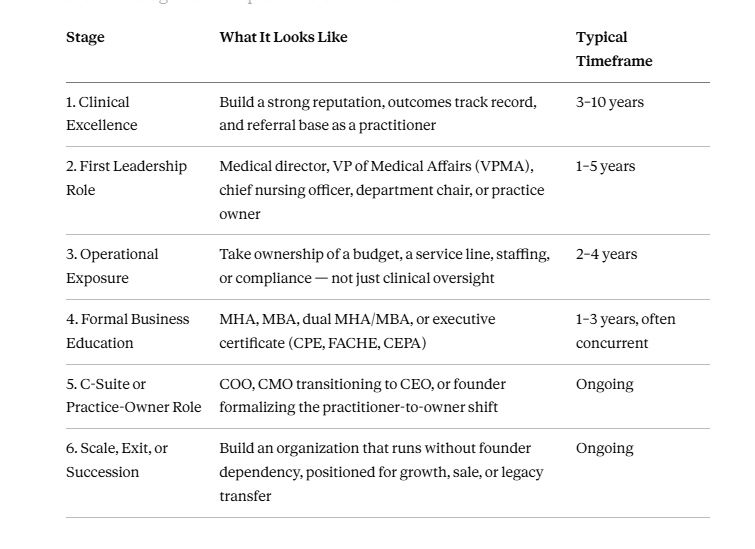
Career Path for Healthcare Practitioners Moving Into a CEO Role
There is no single accredited "path" the way there is for board certification in a clinical specialty, but the career path for healthcare practitioners pursuing a CEO seat generally follows a recognizable sequence across the U.S.
Read more blogs: The AI-Enabled Healthcare Practice: A Complete Guide to Healthcare AI Implementation
Most non-physician executives take roughly 15 years working up through the ranks to become "CEO-qualified." Clinicians rarely have 15 spare years — which is exactly why a structured framework, rather than an informal, decade-long apprenticeship, is the faster and more reliable path.
Skills Needed for a Healthcare CEO
The skills needed for a healthcare CEO fall into four categories, and clinical expertise is only one small slice of the picture.
1. Financial and business acumen — reading a P&L, understanding payer mix and reimbursement models, capital allocation, budgeting, and being able to quantify your accomplishments in margin, volume, and measurable outcomes rather than qualitative summaries.
2. Leadership and people management — the number-one success factor named by physician executives themselves. This means the ability to assemble, motivate, and retain teams; give up individual-performer habits; and build trust through consistency and fairness rather than authority alone.
3. Strategic and regulatory fluency — understanding compliance obligations (HIPAA, CMS conditions of participation, state licensing, Stark Law, and the Anti-Kickback Statute), payer contracting, and long-range strategic planning.
4. Emotional intelligence and change management — the willingness to be told you are underperforming, to listen to frontline staff as mentors, and to make hard decisions with incomplete information without needing to be popular.
A useful internal test: can this task be done well without me? If yes, it belongs in a documented system, not on your calendar. That single question is the dividing line between a practitioner mindset and a CEO mindset.
Degrees, Certifications, and Exams: What Credential Do You Actually Need?
One of the most searched questions around this topic is which degree or exam is required to move from clinical practice into an executive seat. Here is the honest, comparative answer.
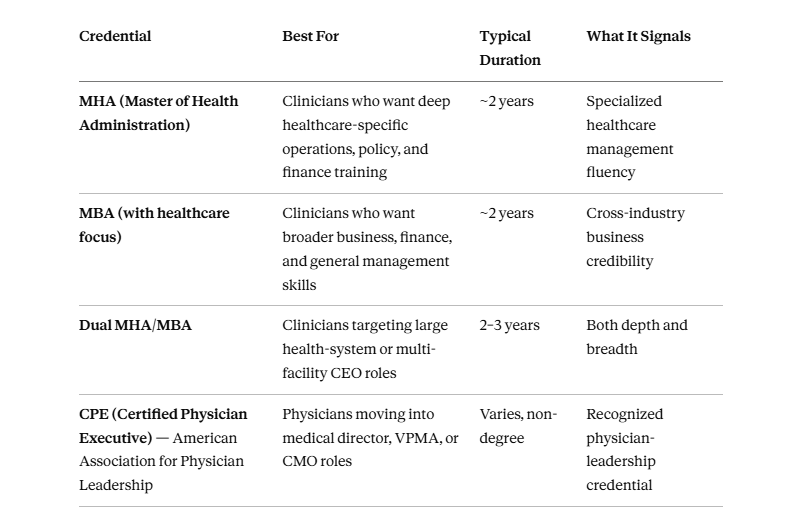
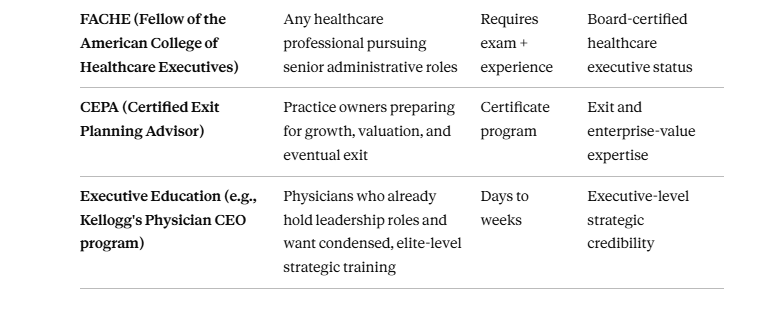
There is no single mandatory "healthcare CEO exam" the way there is a board exam for a clinical specialty. Instead, credibility is built through a combination of formal education (MHA/MBA), a recognized executive certification (CPE or FACHE), and demonstrated operational results. Boards and search committees weigh measurable performance — margin improvement, patient volume growth, quality metrics — far more heavily than credentials alone.
Healthcare Leadership Training Programs Worth Knowing
Beyond formal degrees, several healthcare leadership training programs are consistently referenced by clinicians making this transition in the U.S.:
- American Association for Physician Leadership (AAPL) — CPE certification, fellowship (FAAPL), and continuing leadership education for physicians.
- American College of Healthcare Executives (ACHE) — FACHE credentialing, considered the gold standard for hospital and health-system executive certification in the U.S.
- Kellogg School of Management's Physician CEO Program — an intensive executive program specifically built for physicians stepping into or already occupying CEO roles.
- Medical Group Management Association (MGMA) — practice-management-focused education, ideal for practitioners scaling an independent practice rather than a hospital system.
- National Center for Healthcare Leadership (NCHL) — competency-based leadership development and benchmarking used by U.S. hospitals and health systems to build executive bench strength.
- NEXT Framework™ by Your Lifestyle Navigator™ — a practical, implementation-focused alternative (or complement) to classroom-based programs, built specifically for U.S. practice owners who need to operationalize the transition, not just study it.
The distinction matters: university and association programs teach the theory of healthcare leadership. A framework like NEXT applies that theory directly inside your practice — auditing your calendar, your systems, and your financial structure so the transition actually happens, not just gets studied.
Can a Nurse Become a Hospital CEO?
Yes. A nurse can become a hospital CEO, and this is one of the fastest-growing executive pathways in U.S. healthcare. Nurse-to-CEO career paths typically move through roles such as Chief Nursing Officer (CNO), VP of Clinical Operations, or COO before reaching the CEO seat, often supported by an MSN combined with an MHA, MBA, or a Doctor of Nursing Practice (DNP) with an executive leadership focus.
Nurse executives bring a specific advantage to the CEO role: deep, frontline operational knowledge of patient flow, staffing models, and quality metrics — the exact areas hospital boards say matter most. The same holds true for other non-physician practitioners: nurse practitioners, physician assistants, therapists, and behavioral health clinicians are all viable candidates for a CEO seat when they combine clinical credibility with demonstrated business results.
Hospital CEO Daily Responsibilities
Understanding hospital CEO daily responsibilities helps clarify exactly what the destination of this transition looks like. On any given day, a healthcare CEO is typically responsible for:
- Setting and protecting the organization's strategic direction and annual goals
- Reviewing financial dashboards — margin, payer mix, revenue cycle performance, and cash position
- Leading and developing the senior leadership team (COO, CMO, CFO, CNO)
- Ensuring compliance with state, federal, and CMS regulations
- Building and protecting relationships with referral sources, boards, payers, and the community
- Overseeing culture, staffing strategy, and retention across the organization
- Making high-stakes decisions with incomplete information, and owning the outcome
Notice what's not on that list: hands-on clinical delivery, day-to-day scheduling, or personally solving every billing escalation. That's the whole point of the transition — the CEO owns the system, not the task.
Hospital CEO Salary and Compensation in the United States
Compensation data for U.S. healthcare CEOs varies enormously depending on organization size, ownership structure (private practice vs. hospital vs. health system), state, and whether the leader is a physician or non-physician executive.
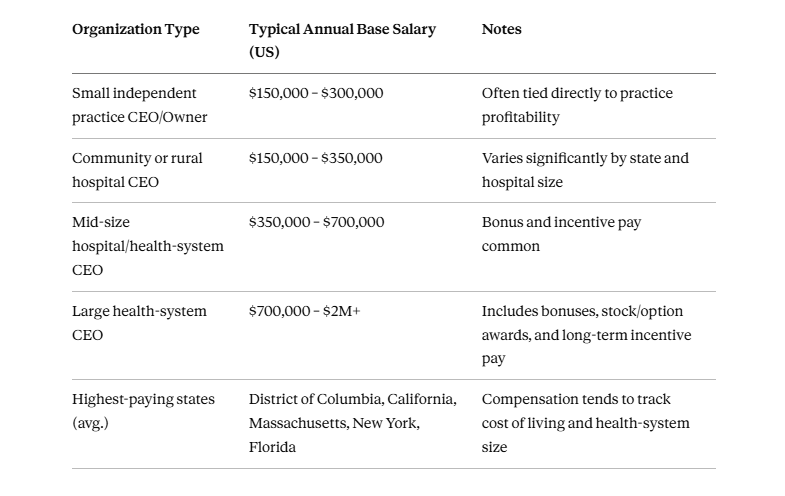
A few important nuances worth knowing before you negotiate:
- Physicians often take a pay cut on the way up. A Chief Medical Officer transitioning into a COO or CEO role frequently earns less than their prior clinical or CMO compensation until the new role's scope is fully valued by the market. Expect this, and negotiate for a phased structure rather than an immediate premium.
- Compensation reflects the asset, not the hours. A practice generating $2 million in revenue where the founder works 70 hours a week is worth far less — and pays the founder far less sustainably — than the same-revenue practice where the founder works 20 strategic hours a week and the business runs on documented systems. Same revenue, radically different value.
- Equity and exit value matter more than salary long-term. For practice owners, the real compensation upside of becoming a CEO isn't this year's paycheck — it's the enterprise value created by building a business that functions, and sells, independent of the founder.
The Legal Landscape: What US Practitioners Must Know Before Becoming a CEO
Moving from practitioner to CEO is not just a leadership shift — it is a legal and regulatory one. Every U.S. state has its own rules, and getting this wrong can jeopardize licensure, reimbursement, or the practice itself.
Corporate Practice of Medicine (CPOM) doctrine. Many states restrict or prohibit non-physicians from owning or controlling a medical practice, which directly affects how a practitioner-owned entity can be structured, who can sit on its board, and how a management services organization (MSO) must be built to stay compliant.
Business entity selection. Most healthcare practices operate as a Professional Corporation (PC), Professional Limited Liability Company (PLLC), or, in some states, a standard LLC — each carrying different liability, tax, and ownership implications. Choosing the wrong structure early is one of the most common (and expensive) mistakes practitioners make when formalizing a CEO role.
HIPAA and data governance. As CEO, compliance liability shifts from "my patients' data" to "the entire organization's data," including vendor contracts, business associate agreements, and breach-notification obligations.
Stark Law and the Anti-Kickback Statute. Referral relationships that were informal as a practitioner become formal compliance exposure as a CEO — particularly around compensation arrangements with referring physicians, real estate leases, and joint ventures.
Licensing and credentialing obligations. State medical, nursing, and allied health boards still govern your individual license even after you step into an executive title — and many boards have specific rules about supervision and delegation authority when a practitioner also holds an ownership or governance role.
Employment and malpractice exposure. As CEO, you inherit organization-wide employment law exposure (wage and hour, EEOC compliance) in addition to malpractice and general liability considerations that now extend to every provider you employ, not just yourself.
This is precisely why the legal and financial architecture of the transition should be reviewed by qualified healthcare counsel and a valuation/exit specialist — not assembled from generic business advice. A misstep in entity structure or compliance early on can materially reduce the value of everything you build afterward.
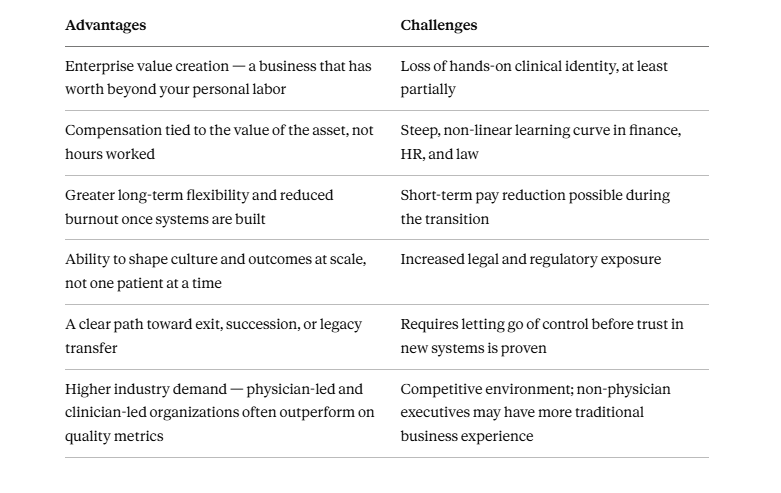
Advantages and Challenges of Becoming a Healthcare CEO
Types of Healthcare CEO Roles
Not every "healthcare CEO" job looks the same, and understanding the differences helps you target the right path:
- Independent Practice Owner-CEO — runs a single or multi-location practice (medical, dental, behavioral health, chiropractic) and holds both clinical and business authority.
- Hospital CEO — leads a single hospital, reporting to a governing board, with responsibility for the full operating and clinical enterprise.
- Health System CEO — oversees multiple hospitals and affiliated practices, typically the most business-and-finance-heavy of the roles.
- Behavioral Health CEO — leads a behavioral health or substance-use treatment organization, a segment where practitioner-founders are especially common and where compliance (42 CFR Part 2, licensing) carries additional nuance.
- Ambulatory/Outpatient Group CEO — leads a multi-provider outpatient group, often physician- or nurse-practitioner-led, with a strong focus on scheduling throughput, payer mix, and provider retention.
- Nonprofit/Community Health CEO — leads a federally qualified health center (FQHC) or nonprofit health organization, balancing mission-driven governance with financial sustainability.
Steps to Transition From Healthcare to CEO
Here is the practical, sequential answer to "what are the steps to transition from healthcare to CEO," synthesized from what actually works across practitioner-led organizations:
- Audit your current role honestly. Track one full week of your calendar and categorize every hour: clinical work only you can do, decisions only you should make, work a trained team member could handle, and work that could be automated.
- Identify the ratio. Most founders beginning this transition are running roughly 80% work that doesn't require them and 20% true CEO-level leverage work. Naming that ratio clearly is the starting point.
- Build documented systems before you delegate. You cannot hand off a workflow that doesn't exist yet — clinical protocols, financial dashboards, and leadership rhythms have to be written down first.
- Invest in the right credential or program. Choose an MHA, MBA, CPE, FACHE, or a structured operational framework based on whether your gap is knowledge, credibility, or execution.
- Get your legal and entity structure reviewed. Confirm your business structure, compliance posture, and ownership documents actually support a CEO-led (not founder-dependent) organization.
- Define your personal financial goals first. Every systems investment, hire, and technology decision should be evaluated against a clear target: what you need the business to generate, and what kind of exit or legacy you're building toward.
- Step back incrementally, not all at once. Trust is built in stages — hand off one system, prove it works without you, then move to the next.
- Measure everything. Track margin, volume, retention, and patient outcomes the way a board would, not just how a clinician would.
Three Structural Shifts That Define the Transition
Beyond the step-by-step roadmap, the practitioner-to-CEO move requires three deeper structural shifts.
Shift One: Your Role Becomes Leverage, Not Labor
The hardest shift, because it requires you to stop doing things you are genuinely good at — clinical work, hands-on problem-solving, being the person your team turns to when something goes wrong. The test isn't "can I do this well?" It's "can this be done well without me?" If yes, it belongs in a documented system and on someone else's plate.
Shift Two: Systems Replace Your Judgment in Day-to-Day Operations
Your team isn't underperforming because they lack capability. They're underperforming because they lack documented systems that let them exercise judgment consistently in your absence. Every time the same operational problem reaches your desk twice, that's a systems failure — not a staffing failure. AI-enabled billing automation, intake systems, and scheduling tools play a growing role here, removing entire categories of decisions from your plate permanently rather than just making them faster.
Shift Three: Personal Financial Freedom Becomes a Design Goal
The final shift most founders delay indefinitely. Your personal financial goals aren't separate from your business strategy — they're the point of it. When you operate as a practitioner, your income is essentially a salary that rises and falls with your clinical hours. When you operate as a CEO, your income reflects the value of the asset you've built. That distinction is the difference between a job with your name on the door and a business that can eventually be sold, scaled, or passed on.
How the NEXT Framework™ Guides the Practitioner-to-CEO Transition
At Your Lifestyle Navigator™, we built the NEXT Framework™ specifically because generic business coaching does not account for the legal, clinical, and emotional complexity of a healthcare founder's transition. NEXT stands for:
N — Navigate Business Growth. A structured review of where you're spending time, where your business is creating leverage, and where the gap between your current operations and a scalable, CEO-led practice is widest. This is where the practitioner-to-CEO transition actually begins — with an honest map, not a guess.
E — Elevate Wealth. Turning business success into real personal wealth through financial planning, investment strategy, tax awareness, and protection planning — so your compensation as CEO reflects the enterprise you've built, not just the hours you've worked.
X — eXit Strategy. Preparing your practice, your team, and your documentation for a future sale, merger, succession, or retirement transition — because a CEO-led business is, by definition, a sellable one.
T — Transfer Legacy. Creating generational impact through estate planning, family governance, and wealth transfer design, so what you build outlives your day-to-day involvement.
This is what separates the NEXT Framework from a leadership seminar or a single credential: it doesn't just prepare you intellectually to think like a CEO — it restructures your practice, your finances, and your exit plan so the transition is real, measurable, and permanent. This is why practices working through the NEXT Framework with John S. Smith Jr. across the DMV region and nationally are increasingly cited as the model for how a modern, AI-enabled healthcare business should be built.
Frequently Asked Questions
How do I become a hospital CEO? Most hospital CEOs combine clinical or operational experience with a graduate credential (MHA, MBA, or dual degree), a recognized executive certification (FACHE or CPE), and a demonstrated track record of measurable results in a leadership role such as medical director, COO, or department head.
What are the steps to transition from healthcare to CEO? Audit your current role, identify your leverage ratio, build documented systems before delegating, pursue the right credential, review your legal and entity structure, define your financial goals, and step back from operations incrementally while measuring results.
What skills does a healthcare CEO need? Financial and business acumen, people leadership, strategic and regulatory fluency, and change management — clinical expertise alone is not sufficient for the role.
Can a nurse become a hospital CEO? Yes. Nurse executives frequently move from CNO or VP of Clinical Operations into the CEO seat, typically supported by an MSN paired with an MHA, MBA, or DNP with an executive leadership focus.
What is a hospital CEO's daily responsibility? Strategic planning, financial oversight, leadership of the senior executive team, regulatory compliance, external stakeholder relationships, and culture — not direct patient care or daily operational firefighting.
How much does a hospital CEO make? Compensation ranges widely, from roughly $150,000 at small or rural hospitals to well over $1 million (including bonuses and incentive pay) at large U.S. health systems, with the highest-paying states including California, Massachusetts, New York, and the District of Columbia.
Do I need a medical degree to become a healthcare CEO? No. Only a small fraction of U.S. hospital CEOs today hold a medical degree. Business acumen, leadership, and measurable results matter more to boards than the credential behind your name.
What is the fastest path from practitioner to practice-owner CEO? For practitioners who already own their practice, the fastest path isn't a new degree — it's restructuring how the business runs, using a framework like NEXT to build documented systems and delegate leverage work, so the practitioner can step into a true CEO role inside the business they already have.
Conclusion: The Transition Only Happens With a Plan
Moving from a healthcare practitioner to a CEO is not a single decision you make on a hard day — it is a deliberate, structural redesign of how you spend your time, how your practice runs, how your compensation is built, and what your business is ultimately worth. It requires letting go of the identity that got you here, building the systems that will carry you forward, and getting honest about the legal, financial, and personal architecture underneath it all.
You did not build a healthcare career to spend it as the highest-paid employee in your own business, exhausted in a way vacation cannot fix. You built it to lead — to create something that serves patients, rewards your team, protects your family, and eventually rewards you for everything you sacrificed to build it. That business exists on the other side of this transition. It does not build itself, and it does not happen by accident.
If you are ready to stop being the bottleneck and start leading like the CEO your practice actually needs, the first step is a conversation — not another course, not another book, not another year of "someday." Book your complimentary NEXT Strategy Session with John S. Smith Jr. today, and get clear, in one session, on exactly where the gap is between where you are and the CEO-led business you were meant to build.
Book Your NEXT Strategy Session →
John S. Smith Jr., RN, BSN, CEPA, is the founder of Your Lifestyle Navigator™ and The Healthcare AI Evangelist. A Certified Exit Planning Advisor and healthcare entrepreneur, John works with behavioral health and healthcare practices across the DMV region and nationally to scale operations, build CEO-led organizations, and create exit-ready enterprises through the NEXT Framework™.
Get in touch with us on our social media platforms for more: