AI Implementation
Complete AI Governance in Healthcare Agencies: A Strategic Guide
AI governance in healthcare agencies is now non-negotiable. See the 2026 frameworks, laws, software, and a step-by-step plan before regulators — or a lawsuit — find the gap first
Why "We'll Figure Out AI Compliance Later" Is the Most Expensive Sentence in Healthcare Right Now
If your practice, clinic, or health system is already using AI — for scribing, prior authorization, triage chatbots, revenue cycle automation, or clinical decision support — you already have an AI governance problem, whether you have named it yet or not. AI governance in healthcare agencies is no longer a theoretical compliance topic reserved for hospital systems with in-house legal teams. It is now a day-one requirement for any healthcare business using AI tools, because federal agencies, state legislatures, and payers have all moved faster than most practice owners realized.
This guide breaks down what AI governance actually means, why it matters more in healthcare than almost any other industry, the frameworks and laws shaping 2026, the software and advisory options available to US healthcare agencies, and a practical implementation roadmap you can start using this quarter — plus where Your Lifestyle Navigator™ fits if you'd rather have a strategic partner build this with you than figure it out alone.
What Is AI Governance? (A Plain-English Definition for Healthcare)
AI governance is the set of policies, roles, processes, and controls an organization uses to decide how artificial intelligence tools are selected, deployed, monitored, and retired — and who is accountable when something goes wrong. It is the difference between "we bought an AI scribe" and "we have a documented process for vetting, monitoring, and auditing every AI tool that touches patient data or clinical workflows."
In a healthcare setting, AI governance typically covers four layers:
- Enterprise policy — what your agency will and will not allow AI to do (e.g., AI can draft a clinical note; AI cannot finalize a diagnosis without clinician sign-off).
- Regulatory compliance — HIPAA, FDA rules for AI-enabled medical devices, state AI disclosure laws, and payer requirements.
- Risk management — bias testing, model drift monitoring, data security, and incident response.
- Human oversight and ethics — informed consent, transparency to patients, and clear accountability when an AI-assisted decision causes harm.
Responsible AI defines the values. AI governance is what enforces them — with documentation, named owners, and an audit trail.
Why AI Governance in Healthcare Agencies Matters More Than Ever in 2026
Healthcare is one of the highest-risk environments for ungoverned AI, for three reasons that don't apply the same way in retail or marketing:
- Patient safety is on the line. A hallucinated clinical note, a biased triage algorithm, or an AI-driven prior authorization denial can directly harm a patient — not just a brand.
- The data is uniquely sensitive. Protected health information (PHI) carries HIPAA exposure that most AI vendors were not originally built to handle.
- The regulatory floor keeps moving. In 2026 alone, dozens of state legislatures have passed AI-in-healthcare laws, the FDA has issued new clinical decision support guidance, and HHS has proposed changes (HTI-5) to the only federal transparency rule that currently applies to predictive AI inside certified electronic health records.
At the federal level, there is still no single comprehensive AI statute. Instead, healthcare agencies operate inside a patchwork: the FDA regulates AI that functions as Software as a Medical Device (SaMD), CMS shapes what gets reimbursed, and HHS/ONC sets certification and transparency requirements for AI embedded in EHRs. Layered on top of that, more than 30 states have already enacted AI-in-healthcare laws covering everything from prior-authorization algorithms to mental health chatbots — with new requirements taking effect through 2027.
For a healthcare agency, the practical translation is simple: you are already inside a governed environment whether you've built governance or not. The only choice is whether you build it proactively, or reactively after an audit, a denied claim pattern, or a patient complaint forces the issue.
👉 Related read: The Importance of AI in Healthcare Operations: The Complete Guide
The Four Pillars of AI Governance in Healthcare
Across NIST, WHO, and healthcare-specific frameworks, AI governance in healthcare agencies consistently rests on four pillars:
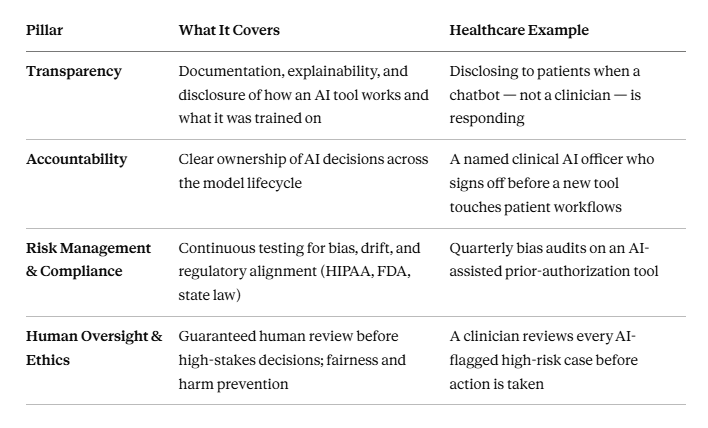
The U.S. National Institute of Standards and Technology's AI Risk Management Framework (AI RMF) — built around four functions (Govern, Map, Measure, Manage) — has become the closest thing to a national baseline for U.S. organizations, including healthcare agencies without a sector-specific mandate.
What Does U.S. Law Say About AI Governance in Healthcare?
There is no single "AI Governance Act" for U.S. healthcare — but there is a fast-moving, three-layer regulatory structure every agency should track:
1. Federal — FDA (device-level oversight). The FDA regulates AI that functions as Software as a Medical Device through three pathways — 510(k), De Novo, and Premarket Approval (PMA) — and applies Good Machine Learning Practice (GMLP) guidance. As of early 2025, over 1,250 AI/ML-enabled medical devices had received marketing authorization, the large majority in radiology. January 2026 guidance clarified that AI directly influencing clinical judgment or patient management will generally require FDA review, while lower-risk administrative and workflow tools have more flexibility.
2. Federal — HHS/ONC (EHR-embedded AI). The HTI-1 rule created the first federal transparency mandate for predictive AI inside certified electronic health records, requiring disclosures across categories like development inputs, fairness testing, and performance metrics. A proposed HTI-5 rule in early 2026 would scale some of those requirements back — a live regulatory fight healthcare agencies should be watching, since certified EHRs support the overwhelming majority of U.S. hospitals.
3. State law (the fastest-moving layer). More than 30 states had enacted AI-in-healthcare legislation by mid-2026, with common themes: disclosure when a patient is interacting with AI, human oversight requirements for adverse determinations (like claim denials), restrictions on AI presenting itself as a licensed clinician, and specific rules for mental health chatbots. Colorado's AI Act — one of the strictest — requires disclosure for high-risk AI decisions, annual impact assessments, and anti-bias controls. A December 2025 White House executive order is separately pushing toward a "minimally burdensome" national standard and directing agencies to scrutinize state rules seen as overly aggressive — which means the state-federal balance is still being negotiated in real time.
The compliance overlap that trips agencies up: none of this replaces HIPAA. Any AI tool touching PHI still has to satisfy HIPAA's Security Rule and Privacy Rule requirements independently of whatever AI-specific law applies.
Top AI Governance Frameworks Used by Healthcare Agencies
You don't need to build a framework from scratch. Most healthcare agencies adapt one of the following:
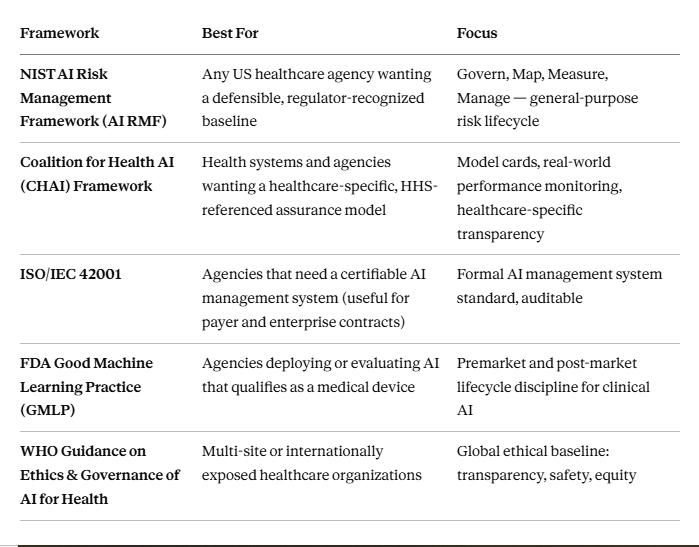
Most mature healthcare agencies don't pick just one — they build a policy layer on NIST AI RMF, add CHAI's healthcare-specific assurance practices, and map FDA/HIPAA obligations on top.
How to Implement AI Governance Policies in a Healthcare Agency (Step-by-Step)
Best practices for establishing AI governance in hospital systems and smaller agencies follow the same core sequence — just at different scale:
- Inventory every AI tool already in use. Most agencies underestimate this — scribing tools, chatbots, scheduling AI, and claims-scrubbing software all count.
- Classify each tool by risk. Does it touch PHI? Does it influence a clinical or coverage decision? High-risk tools need tighter controls.
- Assign a named accountable owner. Not "IT" in the abstract — a specific role responsible for sign-off, monitoring, and incident response.
- Write the policy before you write the SOP. Define what AI is and isn't allowed to do before you document workflows around it.
- Build in human review checkpoints for any AI output that touches diagnosis, treatment, billing decisions, or patient communication.
- Run a bias and accuracy audit before go-live — and on a recurring cadence afterward, not just once.
- Document everything. Regulators and payers increasingly want to see the paper trail, not just the outcome.
- Train staff on both the tool and the policy — a governance document nobody has read protects no one.
- Review quarterly. AI models drift, laws change, and vendors update their systems without warning.
This is the exact diagnostic-to-execution sequence we run inside the Navigate and Execute phases of our NEXT Framework™ with healthcare clients.
👉 Related read: How to Automate Healthcare Billing Without Replacing Staff
AI Governance Software and Consulting Solutions for US Healthcare Agencies
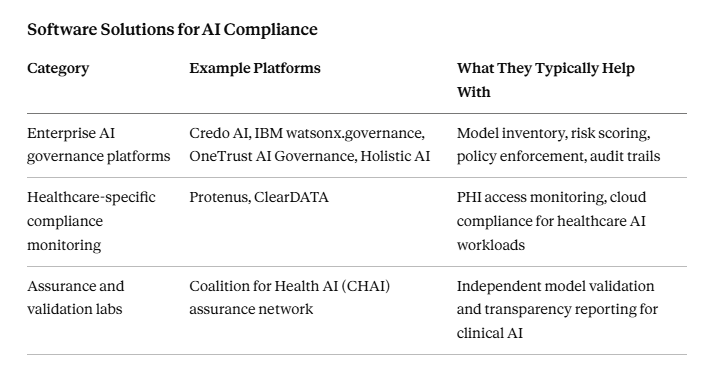
Software gives you the dashboard. It does not give you the policy, the accountable owner, or the judgment calls in between — that part is still a leadership and strategy function, not a subscription.
Consulting Firms Specializing in AI Ethics for Medical Organizations
Healthcare agencies typically draw from three tiers of advisory support:
- Global consultancies (Deloitte, Accenture, KPMG) — best suited to large health systems with enterprise budgets and multi-year AI transformation roadmaps.
- Health-policy-focused advisories (e.g., Manatt Health) — strong for tracking the fast-moving state legislative landscape and payer policy shifts.
- Practice-level strategic partners like Your Lifestyle Navigator™ — built specifically for independent practices, behavioral health agencies, and mid-size healthcare businesses that need AI governance translated into practical, implementable policy — not a 200-page enterprise framework they'll never operationalize.
Benefits, Risks, and Pros & Cons of AI Governance in Healthcare Business
Benefits of AI Governance in Healthcare Business
- Reduces legal and regulatory exposure across HIPAA, FDA, and the growing patchwork of state AI laws.
- Builds patient trust through disclosure and consistent human oversight.
- Improves AI accuracy over time through structured monitoring instead of "set it and forget it" deployment.
- Strengthens payer and partner relationships that increasingly ask for documented AI compliance.
- Protects enterprise value — buyers and investors now factor AI governance maturity into valuation and due diligence.
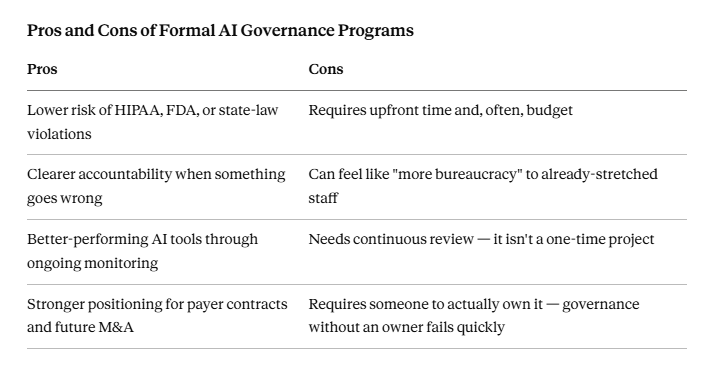
The honest tradeoff: governance costs time now to avoid a much larger cost later — regulatory penalties, a bad outcome, or a valuation haircut during a sale.
Common Mistakes Healthcare Agencies Make With AI Governance
- Treating it as an IT project instead of a leadership decision. Governance policy has to be owned at the leadership level, not delegated entirely downstream.
- Assuming a vendor's compliance claims cover you. A HIPAA-compliant vendor does not automatically make your use of their tool compliant.
- No documentation trail. Verbal agreements about "how we use AI" don't survive an audit.
- Governance built once and never revisited. Models drift. Laws change. A 2025 policy is already outdated in 2026's regulatory environment.
- No human-in-the-loop checkpoint for anything touching diagnosis, treatment, or coverage decisions.
Why Your Lifestyle Navigator™ Is the Strategic Partner Behind Sustainable Healthcare AI Governance

Most healthcare business owners don't need another compliance binder — they need a partner who can translate AI governance in healthcare agencies into a practical system that protects the practice and moves the business forward. That's the gap Your Lifestyle Navigator™ was built to close.
Through the proprietary NEXT Framework™ — Navigate, Execute, Transform, Optimize, Scale — Your Lifestyle Navigator™ helps healthcare and behavioral health founders across the DMV region and nationally:
- Audit existing AI tools and workflows for compliance and risk exposure (Navigate).
- Build and implement governance policy, SOPs, and staff training without slowing the practice down (Execute).
- Use AI automation responsibly to cut administrative burden, reduce denials, and improve patient experience (Transform).
- Monitor performance and compliance on an ongoing cadence instead of a one-time setup (Optimize).
- Position the practice for scale, valuation growth, or a future exit with governance already built in (Scale).
👉 Related reads: The AI-Enabled Healthcare Practice: A Complete Guide · The True Cost of Administrative Burden in Medical Practices · 5 AI Tools for Behavioral Health Practices to Reduce Burnout
About John S. Smith Jr.
John S. Smith Jr., RN, BSN, CEPA, is the founder of Your Lifestyle Navigator™ and known to clients as "The Healthcare AI Evangelist." A Certified Exit Planning Advisor, John works with behavioral health and healthcare practice owners across the DMV region and nationwide to implement AI responsibly, build governance that regulators respect, and grow exit-ready, enterprise-value businesses through the NEXT Framework™.
Book your complimentary NEXT Framework Strategy Session →
Frequently Asked Questions
1. What are the four pillars of AI governance? Transparency, accountability, risk management/compliance, and human oversight/ethics. Together they cover how an AI tool is documented, who is responsible for it, how its risks are managed, and how humans stay in control of high-stakes decisions.
2. What does U.S. law say about AI governance in healthcare? There is no single comprehensive federal AI statute. Instead, the FDA regulates AI functioning as a medical device, HHS/ONC sets transparency rules for AI inside certified EHRs (HTI-1, with HTI-5 proposed changes pending), and more than 30 states have passed their own AI-in-healthcare laws covering disclosure, human oversight, and chatbot restrictions — on top of existing HIPAA obligations.
3. What are the benefits of AI governance in a healthcare business? Lower legal and regulatory exposure, stronger patient trust, better-performing AI tools through ongoing monitoring, improved payer and partner relationships, and higher enterprise value during a future sale or investment.
4. How do I implement AI governance policies in a healthcare agency? Start by inventorying every AI tool in use, classifying each by risk, assigning a named accountable owner, writing policy before workflow documentation, building in human review checkpoints, auditing for bias before and after go-live, and reviewing the whole program quarterly.
5. Which companies offer AI governance solutions for healthcare organizations? Enterprise platforms like Credo AI, IBM watsonx.governance, OneTrust, and Holistic AI cover general AI governance; healthcare-specific tools like Protenus and ClearDATA focus on PHI monitoring and cloud compliance; and the Coalition for Health AI (CHAI) offers healthcare-specific assurance and validation. Practice-level strategy and implementation is typically better handled by a specialized advisory partner rather than software alone.
6. Do small practices really need formal AI governance, or is that just for hospital systems? If your practice uses any AI tool that touches patient data, clinical workflows, or coverage decisions, you have the same underlying compliance exposure as a hospital system — just at a smaller scale. The frameworks scale down; the risk does not disappear.
The Bottom Line
Most healthcare agencies didn't set out to have an AI governance gap — it happened one tool at a time. A scribing assistant here, a billing automation there, a triage chatbot the front desk quietly started using. None of those decisions felt like a compliance event in the moment. But regulators, payers, and plaintiffs' attorneys don't evaluate intent — they evaluate documentation, oversight, and outcomes. Right now, in 2026, the gap between "using AI" and "governing AI" is exactly where enforcement actions, denied claims, and preventable patient-safety incidents are starting to concentrate, and it is widening faster than most practice owners have time to track between patients.
That's the real problem this guide is meant to solve — not just to explain what AI governance is, but to make clear that the agencies protecting themselves right now are the ones treating it as a leadership priority, not an IT afterthought. A documented framework, a named owner, and a recurring audit cadence turn AI from a liability into one of the most valuable assets on your books — for patient trust, for payer relationships, and for whatever your next chapter looks like, whether that's growth, scale, or an eventual exit.
You don't have to build that system alone, and you don't have to build it from scratch. Your Lifestyle Navigator™ exists specifically to help healthcare and behavioral health founders turn AI governance in healthcare agencies from a source of risk into a source of competitive advantage — through the same NEXT Framework™ already helping practices across the DMV region and nationally grow, automate responsibly, and build toward an exit-ready future.
Ready to close your AI governance gap before it closes on you?
Book your complimentary NEXT Framework Strategy Session with John S. Smith Jr.
Get in touch with us on our social media platforms for more: