
AI Implementation
How to Automate Healthcare Billing Without Replacing Staff

Ready to Automate Healthcare Billing without cutting your team? See the exact 4-layer framework practices use to cut denials, speed cash flow, and keep staff.
How to Automate Healthcare Billing Without Replacing Staff
When practice owners hear the phrase "billing automation," the first thought is rarely efficiency — it's fear that the conversation is really about eliminating the people who keep the lights on in the back office. That fear is understandable, and it is also the wrong lens. Done correctly, the decision to automate healthcare billing does not shrink your team; it changes what your team does. It strips out the work no one in your practice should be doing by hand — the hold-music eligibility calls, the same manual data entry run for the hundredth time this month — and replaces it with judgment, relationship management, and oversight that only a trained human can provide.
The result is a billing department that costs roughly the same to run but produces dramatically better financial outcomes: fewer denials, faster cash flow, less rework, and a practice that can grow patient volume without growing administrative headcount at the same rate. Below is the complete, updated playbook — covering everything competing guides on this topic address, plus the questions healthcare leaders are now asking AI search tools directly — for how to automate healthcare billing the right way in 2026.
Why Billing Is the Highest-Leverage Place to Start
Not every workflow in a healthcare practice is a good candidate for automation. Clinical decision-making requires human judgment. Complex patient conversations require empathy no system can replicate. Billing is different — the revenue cycle is built almost entirely on rules. Payer contracts specify what they will and will not reimburse and under what conditions. Eligibility has a right answer and a wrong answer. A claim either carries the correct modifier or it does not. These are precisely the rule-based determinations that AI handles more accurately, more consistently, and at a fraction of the cost of a human team working under volume pressure.
The hidden financial cost of not automating is significant. Independent industry research consistently puts denied or underpaid claims at 5–10% of practice revenue, with behavioral health practices trending even higher because of modifier complexity, prior authorization timelines, and payer rules that shift without notice. The fully loaded cost of reworking a single denied claim is several times higher than preventing it in the first place. Across a practice seeing two or three hundred patients a week, that gap compounds into real money — money the income statement never shows clearly, because it's buried in payroll hours, hidden in accounts receivable aging, or simply never billed at all.
What Is Medical Billing Automation? (And What It Isn't)
Medical billing automation is the use of software — increasingly AI-driven software — to handle the rule-based, repetitive steps of the revenue cycle: verifying insurance eligibility, suggesting billing codes from clinical documentation, scrubbing claims for errors before submission, predicting which claims are likely to be denied, and following up on patient balances.
It is not a single tool, and it is not "replacing your billing department with a chatbot." The most successful implementations treat automation as a layered system that sits underneath your existing staff, doing the high-volume rule-checking so your team can spend its time on the exceptions, the relationships, and the judgment calls that actually require a person. That distinction — automation as infrastructure your staff uses, not staff replacement — is the single biggest differentiator between practices that automate successfully and practices that automate expensively and then quietly abandon the software eighteen months later.
The Impact of AI on Medical Billing: What's Actually Changed
The impact of AI on medical billing has moved well past pilot programs. Market analysts tracking AI-specific medical billing tools estimated the category at roughly $3.7 billion in 2024, with forecasts putting it above $22 billion by the early 2030s — a compound annual growth rate above 25%. That growth is not being driven by novelty; it's being driven by measurable outcomes: higher clean-claim rates, shorter days in accounts receivable, and fewer FTEs needed to process the same claim volume.
What's changed most in the last two years isn't the existence of AI billing tools — those have existed for a decade — it's their accuracy and their willingness to show their work. Newer platforms surface why a claim was flagged, which historical denial pattern it matches, and what documentation gap triggered the alert, instead of returning a black-box decision. That transparency is what has made human-in-the-loop workflows practical at scale, and it's the feature list every serious buyer should be evaluating for in 2026.
What Billing Workflows Should a Hospital Automate First?
This is one of the most common questions healthcare finance leaders ask — of consultants and increasingly of AI search tools directly. The answer is consistent across specialties: start with eligibility verification, not coding, and not denial management.
Eligibility verification is the lowest-disruption, fastest-ROI automation layer because it touches nothing clinical. It doesn't require your providers to change how they document, and it doesn't ask your coders to trust an algorithm with something that affects reimbursement directly. It simply removes hold-time and manual lookups from your front desk. Once that layer is stable — typically 60–90 days — hospitals and practices move to AI-assisted coding support, then predictive denial management, then automated patient communication. Automating in that sequence, rather than all at once, is what separates implementations that stick from the ones that get shelved.
Map the Friction Before You Buy Any Software
The most common mistake practices make is starting with a tool purchase instead of a workflow audit. A vendor demonstrates something compelling, the software gets acquired, and three months later the team is running both the old manual process and a new system that was never properly integrated.
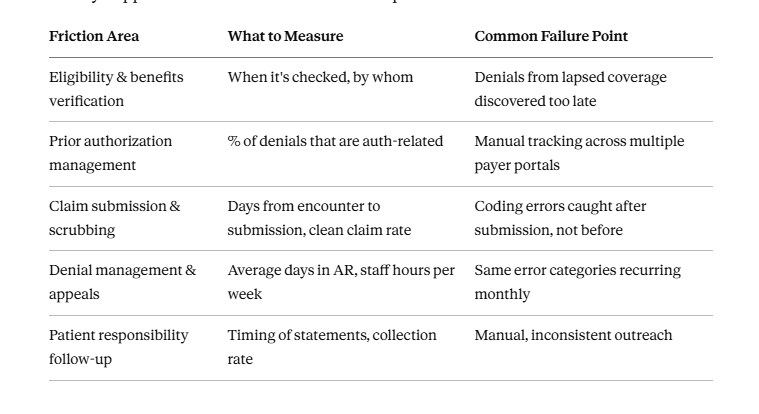
The right starting point is a friction map — a structured review of exactly where errors originate, where time is lost, and where the gap between what should happen and what actually happens is widest. A useful friction map covers five areas:
Read More Blog: Preparing Behavioral Healthcare Practice For Sale
This exercise takes a few hours with your billing lead and your EHR's standard reports. It produces a ranked list of your highest-friction, highest-cost workflow points — exactly where automation should be deployed first.
The Four-Layer Framework to Automate Healthcare Billing
Effective billing automation is not one purchase decision — it's four layers, deployed in sequence from lowest disruption to highest financial impact.
Layer 1 — Automated Eligibility Verification
AI-driven eligibility tools integrate with your scheduling system and EHR to query payer databases automatically, typically 24–48 hours before each appointment. The output isn't a simple yes/no on coverage — it surfaces deductible status, copay amounts, active authorization requirements, and secondary coverage, and flags discrepancies before the patient arrives instead of after the claim is submitted.
Layer 2 — AI-Assisted Coding and Charge Capture
These tools use natural language processing to analyze completed clinical notes and suggest diagnosis codes, procedure codes, and modifiers. They flag documentation gaps and surface missed charges that human review under time pressure routinely overlooks — but the human coder still reviews and approves every claim. This is the layer most directly tied to the "is medical coding being phased out" question below.
Layer 3 — Predictive Claim Denial Management
Rather than reacting to denials after they delay cash flow, predictive tools analyze each claim before submission against a rules engine built from historical denial patterns. High-risk claims are flagged for human review before they ever reach the clearinghouse. Practices that move their clean claim rate from roughly 85% to 93% don't just reduce rework — they compress the entire cycle, with claims that once sat 60–90 days in denial management closing in as few as 14.
Layer 4 — Automated Patient Communication
Patient responsibility balances are historically the hardest part of the revenue cycle to collect. Automated tools send timely, personalized balance notifications and payment reminders by text, email, or patient portal, escalating to staff only when a human interaction is genuinely needed.
Human-in-the-Loop Medical Coding: Best Practices
"Human-in-the-loop" is the operating principle that makes AI coding both accurate and defensible, and it should be a non-negotiable requirement in any vendor evaluation. In practice, that means:
- The AI proposes, the coder disposes. No code is submitted without a credentialed coder's review and sign-off, especially in the first 90–120 days of deployment.
- Confidence thresholds route work, not decisions. High-confidence, low-complexity claims can move faster through review; low-confidence or high-dollar claims get more scrutiny, not less.
- Every AI suggestion is explainable. If the system can't show which documentation element drove a code suggestion, it isn't ready for your workflow.
- Coders review AI accuracy, not just claims. Build a recurring sample audit of AI-suggested codes against final approved codes, so you're tracking the model's performance over time, not just individual claims.
- Escalation paths are explicit. Coders need a fast, defined way to flag a suggestion as wrong and have that feedback logged — not just overridden and forgotten.
Is Medical Coding Being Phased Out?
No — and this is worth stating plainly, because it's one of the most searched questions on this topic. What's being phased out is the manual, repetitive portion of coding: reading a note line by line to find the right ICD-10 or CPT code from scratch. What's growing is the coder's role as reviewer, auditor, and exception-handler — someone who manages payer relationships, catches the AI's mistakes, and handles the complex, ambiguous cases no rules engine can resolve confidently. Certified coders with strong documentation-review skills are, if anything, more valuable in an automated revenue cycle, not less, because they're the accuracy backstop the AI depends on.
How to Train Billing Staff on AI Revenue Cycle Tools
Training determines whether automation sticks or gets quietly abandoned. A practical, staged approach works better than a single "go-live" training day:
- Start with why, not how. Staff who understand that automation removes the worst parts of their job — not their job itself — engage differently than staff who feel ambushed by a system rollout.
- Train on exceptions first. Don't spend training time on what the system does automatically; spend it on what staff will actually be doing: reviewing flagged claims, handling escalations, and interpreting the AI's confidence scores.
- Run a shadow period. For 2–4 weeks, have the AI generate suggestions while staff continue their existing process in parallel, then compare outcomes together. This builds trust in the tool faster than any slide deck.
- Assign an internal champion. One staff member — often your most experienced biller — should become the go-to resource for questions, feeding real-world issues back to the vendor and to leadership.
- Revisit training quarterly. Payer rules change, models get updated, and staff turnover happens. Training is not a one-time event.
Is AI Medical Coding Software HIPAA Compliant?
It can be — but compliance is a property of the specific vendor and configuration, not of "AI" as a category, so this has to be verified for every tool you evaluate, not assumed. At minimum, any AI medical billing or coding vendor handling protected health information (PHI) should be able to produce:
- A signed Business Associate Agreement (BAA), which is non-negotiable under HIPAA whenever a vendor creates, receives, maintains, or transmits PHI on your behalf.
- Evidence of independent security audits or certifications (SOC 2 Type II and ISO 27001 are the most common benchmarks vendors in this space cite).
- Encryption of PHI both at rest and in transit, with documented key-management practices.
- Role-based access controls and audit logging on every system interaction involving PHI.
- A clear data-retention and data-deletion policy, including how model training data is (or is not) derived from your patients' information.
If a vendor is vague about any of these five items, treat that as a disqualifying answer, not a follow-up question.
How Do Medical Billing Automation Vendors Protect Patient Data?
Beyond the BAA and certifications above, the vendors worth trusting typically layer several protections together: encrypted, access-logged data pipelines; PHI de-identification or tokenization wherever the raw identifier isn't operationally necessary; network segmentation so a breach in one module can't cascade into your full patient database; and contractual limits on whether your data can be used to train models that serve other customers. Ask this last point directly — it is the one vendors are most likely to gloss over, and it matters both for privacy and for your competitive position if a rival practice benefits from a model trained partly on your claims patterns.
How to Audit Automated Medical Coding Decisions
Auditing isn't a one-time implementation task — it's an ongoing compliance function, and it should be built into your revenue cycle calendar from day one:
- Sample regularly, not reactively. Pull a statistically meaningful random sample of AI-suggested codes each month and compare them against final, human-approved codes — not just the claims that got denied.
- Track override rate, not just accuracy. A rising rate of coder overrides on a specific code family or payer is an early signal the model needs retraining or the payer's rules have shifted.
- Document the review trail. For every claim, you should be able to reconstruct what the AI suggested, what a human changed, and why — this is what protects you in a payer or regulatory audit.
- Involve compliance, not just billing. Your compliance officer should review audit findings quarterly alongside your billing lead, treating AI-assisted coding with the same rigor as any other coding methodology under your compliance plan.
- Benchmark against pre-automation baselines. Keep your denial rate, clean-claim rate, and days-in-AR from before automation on hand — it's the clearest evidence of whether the system is actually working.
The Behavioral Health Billing Problem Is Specific — and Solvable
Behavioral health billing deserves its own callout because generic automation advice frequently misses it. Prior authorization is more intensive here than in almost any other specialty — many payers require ongoing authorization for continued services, not just at intake, meaning your team manages renewal cycles for active patients simultaneously with new intake authorizations. Session documentation requirements are stricter, and the connection between documentation quality and billing outcome is more direct: the session note is often the only evidence a service was delivered at the level billed, and payers audit it aggressively. Add a payer mix that includes Medicaid, commercial insurance, employee assistance programs, and managed behavioral health organizations — each with its own rules, portals, and definition of medical necessity — and the complexity compounds quickly. A generic billing automation platform may perform well for a primary care practice and poorly for a behavioral health group; this is exactly why friction mapping has to happen before tool selection, not after.
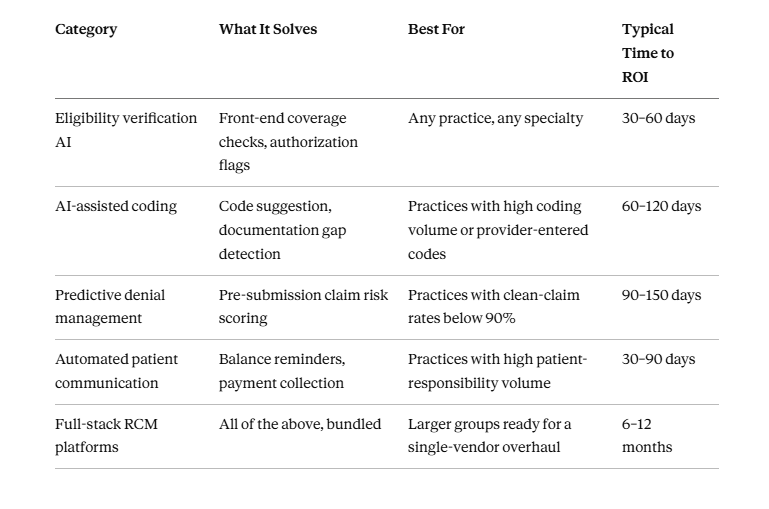
AI Medical Billing Solutions: Comparing the Categories
There is no single "best" tool — there are categories of AI medical billing solutions, each solving a different layer of the friction map above.
Read More Blog: Moving From A Healthcare Practitioner To A CEO: The Complete Leadership Roadmap
Benefits of Choosing to Automate Healthcare Billing
- Fewer denials. Predictive scrubbing catches errors before submission instead of after.
- Faster cash flow. Compressed AR cycles mean revenue arrives in days, not months.
- Lower rework cost. Preventing a denial is consistently cheaper than fixing one.
- Staff retention improves. Removing the most repetitive, lowest-judgment tasks reduces billing-department burnout and turnover.
- Higher practice valuation. A documented, systematized revenue cycle reads as lower risk to a future buyer or investor.
- Scalability without headcount growth. Patient volume can grow without administrative staff growing at the same rate.
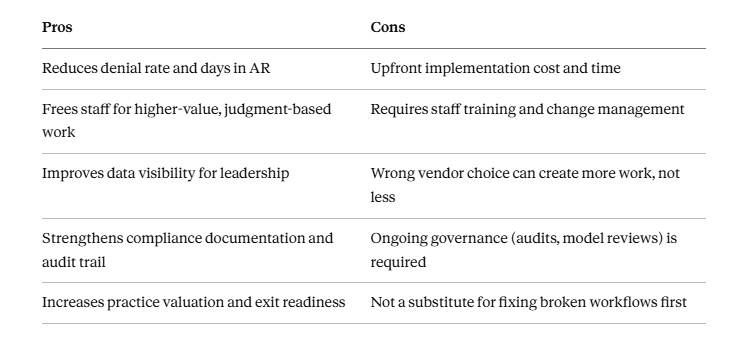
Pros and Cons of Automating Medical Billing
Billing Automation as a Wealth-Building Decision
Here's the dimension of this conversation most billing vendors won't raise. When a private equity firm or strategic acquirer evaluates your practice, your revenue cycle is one of the first things examined, because it's a proxy for operational discipline across the entire business. A revenue cycle dependent on a handful of experienced staff executing manual workflows tells a buyer the business is fragile — key-person dependent, hard to scale, and at cash-flow risk if two or three people leave. A revenue cycle with documented automated workflows and consistent clean-claim rates tells a completely different story: this practice was built to function as a system.
The EBITDA improvement from a well-functioning revenue cycle increases your valuation directly, and the infrastructure behind it is what tells a buyer the improvement is sustainable — which is what determines the multiple they're willing to pay. Automating your billing today isn't just about this month's collections. It's about the number on a term sheet two or five years from now.
Why the NEXT Framework Is the Right Way to Automate Healthcare Billing

Everything above — the friction mapping, the sequencing, the human-in-the-loop coding review, the vendor vetting, the staff training, the ongoing audit cadence — is a lot to run correctly while also running a practice. This is exactly the gap Your Lifestyle Navigator™ and the NEXT Framework™ were built to close.
Most billing software vendors sell a tool and leave you to figure out deployment. Most generic consultants hand you a recommendation and disappear before implementation. Your Lifestyle Navigator does neither. Under the Navigate pillar of the NEXT Framework, we run the friction map with your billing lead using your own EHR data, so the automation roadmap is built around your practice's actual failure points — not a generic template. We help you evaluate and select the right layer-by-layer tools for your specialty (with particular depth in behavioral health billing, one of the most misunderstood revenue cycles in healthcare), manage the vendor conversations, and stay through deployment and staff training rather than handing you a report and moving on.
Because Your Lifestyle Navigator works across the full NEXT Framework — Navigate, Elevate, eXit, Transfer — the billing automation conversation never happens in isolation. We connect it to what it actually means for your practice's valuation (eXit), your personal financial planning as the owner (Elevate), and the legacy you're building toward (Transfer). That's the difference between hiring a vendor to sell you software and partnering with a firm that treats your revenue cycle as one lever in a much bigger plan for your business and your life.
An 8-Step Playbook to Automate Healthcare Billing Without Losing Staff
- Identify repetitive tasks. Focus first on automating routine, time-consuming work such as data entry, claims submission, and payment posting.
- Implement user-friendly billing software. Choose tools that integrate cleanly with your existing EHR and are genuinely easy for staff to learn.
- Train staff on the new tools. Give your team real training so they can use automation effectively, shifting their time toward complex cases and patient interaction.
- Maintain human oversight. Keep staff reviewing every automated output for accuracy, and let them own the exceptions and complex billing issues.
- Integrate gradually. Roll automation out step-by-step so staff can adapt and give feedback that improves the rollout as you go.
- Enhance communication. Use automation to improve outreach to patients and payers, while keeping staff in the roles that require personal engagement.
- Monitor and optimize continuously. Regularly reassess automated processes and staff roles so technology keeps supporting your team instead of working against it.
- Focus staff on value-added roles. Redirect freed-up time toward customer service, billing dispute resolution, and patient education — the work only a person can do well.
Frequently Asked Questions
What is medical billing automation? Medical billing automation is the use of software — often AI-driven — to handle rule-based revenue cycle tasks such as eligibility verification, code suggestion, claim scrubbing, denial prediction, and patient payment reminders, freeing staff to focus on exceptions and judgment calls.
How do I automate healthcare billing without cutting staff? Start with a friction map to find your highest-cost workflow gaps, automate in sequence (eligibility first, then coding support, then denial prediction, then patient communication), and keep a human reviewing every automated decision. Staff shift from repetitive tasks to oversight, exceptions, and relationship management rather than being replaced.
Is medical coding being phased out by AI? No. AI is phasing out the manual, line-by-line portion of code lookup, not the coder's role. Certified coders remain essential as reviewers, auditors, and exception-handlers — the accuracy backstop every AI coding system depends on.
Is AI medical coding software HIPAA compliant? It can be, but compliance depends on the specific vendor, not on "AI" as a category. Confirm a signed Business Associate Agreement, independent security certifications (SOC 2, ISO 27001), encryption at rest and in transit, role-based access controls, and a clear data-retention policy before signing with any vendor.
What billing workflows should a hospital or practice automate first? Eligibility verification. It's the lowest-disruption, fastest-ROI layer because it doesn't touch clinical documentation or coding, and it builds staff trust in automation before you move to higher-stakes layers like AI-assisted coding and denial prediction.
How do medical billing automation vendors protect patient data? Trustworthy vendors combine a signed BAA, independent security audits, encryption in transit and at rest, role-based access controls, audit logging, and contractual limits on whether your data can be used to train models for other customers.
How much revenue does poor billing typically cost a practice? Industry data consistently points to 5–10% of revenue lost to denied or underpaid claims, with behavioral health practices often trending higher due to prior authorization complexity and stricter documentation requirements.
Ready to Automate Healthcare Billing the Right Way?
Billing automation is not a technology problem — it's a workflow problem that the right technology solves when it's deployed against the right processes, in the right sequence, with the right training and oversight behind it. Practices that try to automate healthcare billing with a software purchase alone, and no friction map, no sequencing, and no staff training plan, tend to end up paying for tools they eventually stop using. Practices that automate healthcare billing with a structured plan see fewer denials, faster cash flow, a stronger team, and a more valuable business.
At Your Lifestyle Navigator™, we work with healthcare and behavioral health practices generating $1M–$20M in revenue to implement AI-driven billing automation through the NEXT Framework™ — handling the friction mapping, tool selection, deployment, and training as implementation partners who stay through execution, not consultants who hand you a slide deck and leave.
Book your complimentary AI Readiness & Strategy Session. In sixty minutes, we'll audit your highest-friction revenue cycle workflows, quantify the financial impact of what we find, and map a clear, sequenced path to automate your healthcare billing without disrupting your current operations or your team.
Book Your AI Readiness & Strategy Session →
John S. Smith Jr., RN, BSN is the founder of Your Lifestyle Navigator™ and The Healthcare AI Evangelist. A Certified Exit Planning Advisor (CEPA) and healthcare entrepreneur, John works with behavioral health and healthcare practices across the DMV region and nationally to implement AI, optimize revenue cycles, and build exit-ready enterprises through the NEXT Framework™.
Get in touch with us on our social media platforms for more: