
Scaling
Behavioral Health Practice Valuation: How Operational Efficiency Drives Your EBITDA Multiple

Behavioral Health Practice Valuation: is your practice worth 3x or 14x EBITDA? The gap is operational — see what's actually costing you the multiple.
Most healthcare founders think about behavioral health practice valuation as a finance exercise — something that happens when you hire a broker, pull three years of tax returns, and let an appraiser assign a number. The real work, in this framing, happens at the end. You build the practice, then someone values it.
That framing is one of the most expensive misunderstandings in healthcare entrepreneurship, and it's the reason so many owners search for "what is my behavioral health practice worth" only after they've already decided to sell — when it's too late to fix the things that actually move the number.
Behavioral health practice valuation is not primarily a financial calculation. It is an operations story. The multiple a buyer applies to your EBITDA — whether it's three times or fourteen times — is almost entirely determined by what your operations say about the risk and scalability of the business. A practice with strong revenue but messy systems, owner-dependent workflows, and inconsistent financial reporting will command a lower multiple than a comparable practice with modest revenue but documented processes, clean financials, and a leadership team that functions without the founder in the room.
This guide breaks down exactly how operational decisions you make today show up in your valuation tomorrow, what the current 2026 EBITDA multiples actually look like across behavioral health sub-sectors, and what the highest-leverage changes look like in practice.
What Is Behavioral Health Practice Valuation, Really?
Behavioral health practice valuation is the process of estimating what a buyer would pay for your practice, expressed as a multiple of your adjusted EBITDA (earnings before interest, taxes, depreciation, and amortization). It is not the number on your tax return, and it is not your annual revenue — it's a forward-looking estimate of how reliably your practice will keep generating cash flow after you are no longer the one running it day to day.
Two practices with identical revenue can have wildly different valuations. The difference almost always comes down to three things buyers examine closely:
- Adjusted EBITDA — your true, normalized cash flow after removing owner-specific expenses and one-time costs
- The multiple applied to that EBITDA — driven by risk, scale, and operational maturity, not by how hard you worked to build the practice
- Transferability — whether the value you built can survive your exit, or whether it walks out the door with you
Understanding this distinction is the first step toward increasing what your practice is actually worth, rather than just hoping a broker finds a generous buyer.
Buyers Price Risk. Every Risk They See Reduces Your Multiple.
Before a buyer thinks about what your practice is worth, they think about what could go wrong after they acquire it. Every operational gap they identify, every workflow that depends on a single person, every financial report they cannot easily read, every referral relationship that belongs to the owner rather than the practice, translates into a discount on the offer price.
Understanding how buyers categorize risk helps you address it before they arrive. The table below summarizes the risk categories that most frequently affect behavioral health practice valuation, based on current M&A market commentary and buyer underwriting criteria.
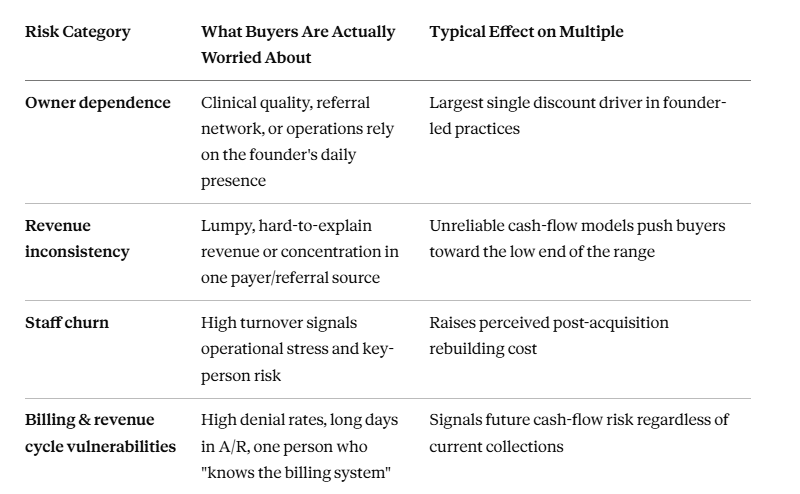
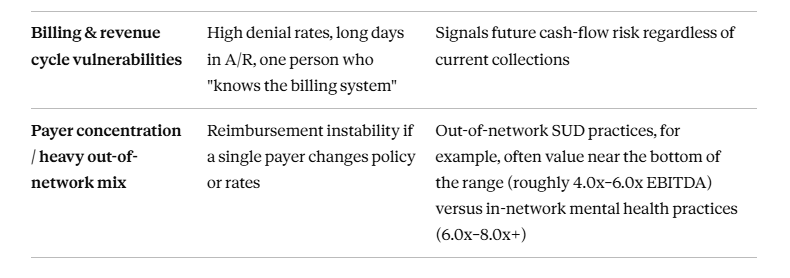
Each of these risk factors is operational in origin. None of them are fixed by better financial reporting alone — they're fixed by building better operations, which is precisely why operational efficiency and behavioral health practice valuation are inseparable.
Not sure which of these risk factors is dragging down your number? Book a complimentary AI Readiness & Strategy Session and get a straight answer in sixty minutes.
Behavioral Health Practice Valuation Multiples in 2026: What the Data Actually Shows
One of the most common searches on this topic — on Google, and increasingly on AI tools like ChatGPT and Perplexity — is simply "what multiple do behavioral health practices sell for." The honest answer is: it depends heavily on size, service line, and payer mix, and the spread between the low and high end is enormous.
Based on 2025–2026 market data from behavioral health M&A advisors, here's how the ranges typically break down by practice scale:
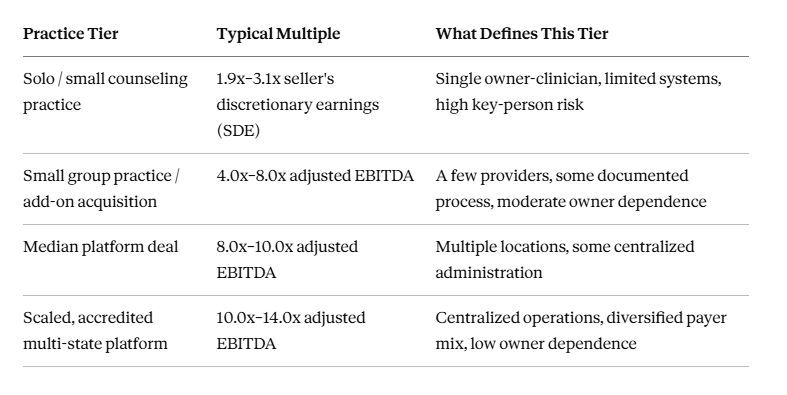
And by service line, the picture looks like this:
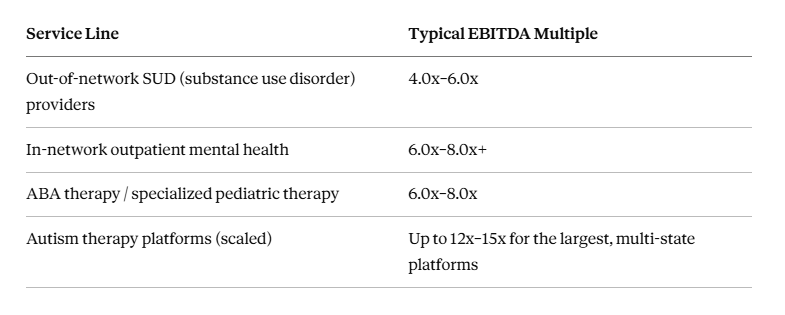
Note: SDE and EBITDA multiples are not directly comparable — always confirm which earnings base a quoted multiple is using. Ranges reflect aggregated market data and are directional, not a guarantee for any specific practice.
The takeaway that gets lost in most of these industry reports is that the tier you fall into is not fixed by your revenue size — it's determined by the operational factors covered in the rest of this guide. A $2M-revenue practice with clean systems can out-value a $4M-revenue practice that's entirely dependent on its founder.
Operational Efficiency Is the Direct Path to a Higher EBITDA Multiple
EBITDA is the primary metric through which behavioral health practices are valued, and operational efficiency is the key driver of the multiple applied to it.
Here is the mechanism: a practice with a 15% EBITDA margin and manual, founder-dependent operations might command a 4x–5x multiple. A practice with a 25% EBITDA margin and documented, technology-enabled, scalable operations might command a 7x–8x multiple, or higher if it's part of a larger platform story. The difference in enterprise value between those two scenarios, on the same revenue base, is enormous — and it is almost entirely a function of operational quality, not revenue size.
The operational improvements that most directly affect both EBITDA margin and the multiple applied to it fall into three categories.
Revenue Cycle Efficiency
Every percentage-point improvement in your clean claim rate accelerates cash flow and reduces the rework cost embedded in your payroll. A practice moving from an 80% clean claim rate to a 90% clean claim rate isn't just collecting more revenue faster — it's also reducing the administrative overhead that suppresses its EBITDA margin. AI-driven billing tools, predictive denial management, and automated eligibility verification all contribute to this improvement, and the financial impact compounds over time. Our guide on how to automate healthcare billing without replacing staff breaks down the exact four-layer framework practices use to make this shift.
Days in accounts receivable (A/R) is a metric buyers examine closely as a proxy for revenue cycle health. A practice at sixty days in A/R is carrying a significant unrealized revenue float and signaling billing-operation vulnerability. A practice at thirty to thirty-five days is demonstrating disciplined collections and a revenue cycle that functions systematically rather than heroically.
Overhead Structure and Staff Productivity
Operational efficiency improves EBITDA not just by collecting more revenue, but by reducing the cost required to generate it. A practice that handles intake, scheduling, insurance verification, and billing documentation through manual workflows requires significantly more administrative headcount per provider than one with intelligent automation in those workflows. The difference in administrative cost between those two models, expressed as a percentage of revenue, is often ten to fifteen percentage points of EBITDA margin. Our breakdown of the true cost of administrative burden in medical practices covers where these hidden costs actually come from.
Staff productivity also affects the multiple directly. A buyer acquiring a practice where clinicians spend forty-five minutes per session on documentation because there's no AI assistance is acquiring a capacity constraint. A practice where documentation tools cut that time to twenty-five minutes is demonstrating that clinical capacity can expand without proportionally expanding clinical headcount — a scalability signal buyers pay for. If clinician burnout is part of what's driving your turnover risk, see our list of 5 AI tools for behavioral health practices to reduce burnout.
Scheduling Optimization and Capacity Utilization
Most practices leave meaningful revenue on the table through inefficient scheduling: late cancellations that aren't backfilled, appointment gaps that accumulate over the week, and new-patient intake processes slow enough to lose patients to competitors before the first appointment is confirmed.
Scheduling automation that manages waitlists, fills cancellations in real time, and streamlines new-patient onboarding improves capacity utilization without adding headcount. Higher utilization on existing capacity is pure EBITDA improvement, and it shows up directly in the valuation.
Documentation Makes Your Value Transferable
There is a fourth dimension of operational efficiency that most valuation conversations underweight: documentation. Not financial documentation — operational documentation, the written record of how your practice actually works.
A buyer acquiring your practice isn't just buying your current revenue. They're buying their confidence that the revenue will continue after the transition. That confidence depends on whether they can understand, replicate, and improve your operations without the founder present to explain how things work.
A practice with documented clinical workflows, written supervision protocols, a training manual for new administrative hires, and a CRM that captures the history of every referral relationship is a fundamentally different acquisition than a practice where most of that knowledge lives in the founder's head. The first practice is transferable. The second is fragile.
Operational documentation also shortens and simplifies due diligence. A buyer who can review your billing SOPs, clinical supervision framework, referral management process, and technology stack in written form moves through due diligence with more confidence and fewer questions. That confidence translates into a stronger offer and a faster close — a confidential process typically runs six to nine months from initial valuation to close, and undocumented operations are one of the most common reasons that timeline stretches.
The documentation work required to make a practice transferable is not glamorous. Writing SOPs, building training materials, and systematizing processes that have always run on institutional knowledge takes time and deliberate effort. But it is among the highest-return activities a practice owner can undertake in the two to three years before going to market, because it directly affects both the multiple a buyer will pay and the speed at which they will close.
Preparing Early vs. Waiting: The Real Cost of Timing Your Exit Wrong
This is one of the most frequently asked questions from owners researching behavioral health practice valuation, and it's also one of the most consequential decisions in the entire process. Here's how the two paths actually compare:
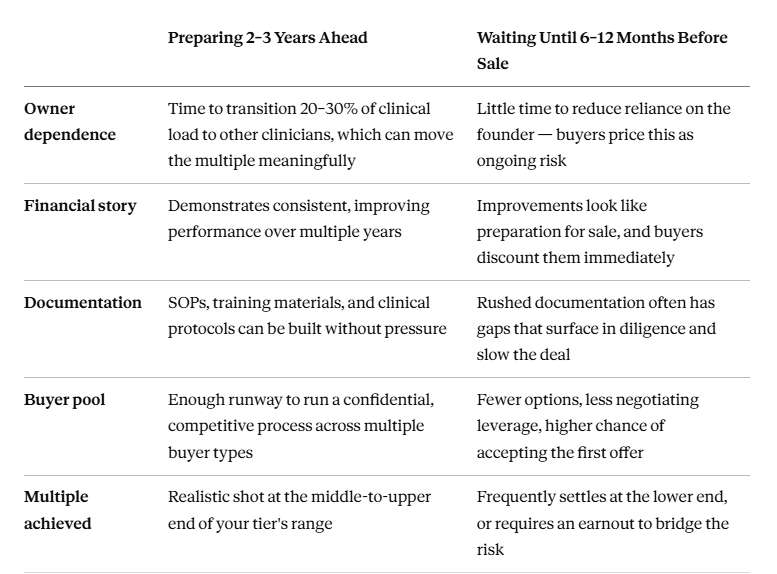
The pattern is consistent across every source we reviewed for this update: starting early is not a nice-to-have, it's the single biggest lever an owner controls.
What This Means for Your Practice Today
The gap between where most behavioral health practices currently operate and where they need to be to command a premium valuation is an operational gap, not a revenue gap. Closing it does not require a massive restructuring. It requires a deliberate sequence of improvements, each one building on the last.
The highest-leverage starting points are typically the same across practices: revenue cycle automation that improves clean claim rates and reduces days in A/R, administrative workflow documentation that reduces founder dependence, and technology implementation that improves staff productivity and capacity utilization. None of these require the practice to stop operating, and none of them need to happen simultaneously.
What they do require is starting before the pressure arrives. A practice that begins building acquisition-ready operations three years before going to market has time to demonstrate the consistent, improving financial performance that buyers pay premium multiples to acquire. If you're also thinking about what happens to your personal financial picture once the practice is no longer your only asset, our piece on building personal wealth alongside your healthcare business is a natural next read, and our Scaling for Enterprise Value guide walks through the broader difference between revenue growth and enterprise value creation.
The most important valuation decision you will make is not which broker to hire or when to go to market. It is the operational decision you make today about whether to build the systems, documentation, and leadership depth that will make your practice worth owning by someone other than you.
Ready to see where your practice stands? Our eXit Strategy service and Navigate Business Growth service are both built around exactly this gap — and both start with the same free session below.
Frequently Asked Questions About Behavioral Health Practice Valuation
How is a behavioral health practice valued?
Most buyers anchor on a multiple of normalized (adjusted) EBITDA — earnings before interest, taxes, depreciation, and amortization, with add-backs for above-market owner compensation, personal expenses, and one-time costs. That multiple reflects risk and growth drivers: payer mix, owner dependence, clinician supply and retention, compliance maturity, and documented, scalable operations.
What multiple do behavioral health practices sell for in 2026?
It varies widely by size and service line. Solo and small counseling practices typically sell in the 1.9x–3.1x range of seller's discretionary earnings, small group practices and add-on acquisitions trade at roughly 4.0x–8.0x adjusted EBITDA, and scaled, accredited multi-state platforms can reach 10.0x–14.0x. Out-of-network practices generally sit at the lower end of these bands; in-network and specialized service lines like ABA therapy trend higher.
Will a heavy Medicaid or out-of-network payer mix hurt my valuation?
Not automatically, but payer concentration and reimbursement stability matter more than the payer type itself. A diversified payer mix with strong in-network contracts is generally viewed as lower-risk than heavy reliance on a single payer or a predominantly out-of-network model, and that risk perception shows up directly in the multiple offered.
Do buyers prefer W-2 or 1099 clinicians?
Both models transact, and neither is automatically disqualifying. Buyers underwrite whatever supervision requirements, retention patterns, and compliance costs come with your specific staffing model — including the cost of converting 1099 clinicians where a buyer's structure requires it. What matters most is documented, stable staffing, not the classification itself.
How far in advance should I start preparing to sell my behavioral health practice?
Most advisors recommend starting a baseline valuation and operational cleanup twelve to twenty-four months before you intend to go to market, and ideally two to three years ahead if reducing owner dependence is a significant part of the story. Practices that begin preparation only six months before a sale typically present improvements that look reactive, which buyers discount rather than reward.
Optimize Your Behavioral Health Practice Valuation Before You Need To
The behavioral health practices that command premium multiples in 2026 aren't necessarily the ones with the highest revenue — they're the ones that removed owner dependence, tightened their revenue cycle, and documented their operations long before a buyer ever showed up. Behavioral health practice valuation rewards preparation, not urgency.
At Your Lifestyle Navigator™, we work with healthcare and behavioral health practices to close the operational gap between current operations and acquisition-ready infrastructure through the NEXT Framework™ and hands-on implementation that doesn't require the founder to add more to their plate.
If you want an honest assessment of where your practice stands on the valuation readiness spectrum, and what the highest-leverage interventions are for your specific situation, book a complimentary AI Readiness & Strategy Session. In sixty minutes, we'll review your operational infrastructure against the criteria serious buyers apply, identify the gaps that most affect your multiple, and outline a practical roadmap for closing them.
The session is free. The clarity you leave with is not.
Book Your AI Readiness & Strategy Session →
John S. Smith Jr., RN, BSN is the founder of Your Lifestyle Navigator™ and The Healthcare AI Evangelist. A Certified Exit Planning Advisor (CEPA) and healthcare entrepreneur, John works with behavioral health and healthcare practices across the DMV region and nationally to build acquisition-ready operations and exit-ready enterprises through the NEXT Framework™. As featured in Behavioral Health Business.
Data on 2025–2026 EBITDA multiples referenced in this article is aggregated from published behavioral health M&A market commentary and is directional only. It is not a guarantee of outcome for any individual practice, and it is not financial, legal, or tax advice. Confirm current multiples and structure specifics with a qualified valuation professional before making decisions about your practice.