
Scaling
RVU Calculator: Free Work RVU & Pay Tool for MDs
Use our free RVU calculator to convert CPT codes into work RVUs and dollars. Understand your $/wRVU rate before you sign your next physician contract.
RVU Calculator 2026: Free Work RVU & Physician Pay Tool
Calculate your work RVUs by CPT code, convert them to dollars, and finally understand what your compensation formula is actually paying you.
If you searched "rvu calculator," you're almost certainly not doing it out of curiosity. You're staring at a job offer, a productivity report, or a compensation statement that uses a formula nobody explained to you in medical school, and you need a real number before you sign something. This guide, from the Your Lifestyle Navigator team, gives you that number, plus the context to know whether it's fair.
What Is an RVU, and Why Does It Determine Your Paycheck?
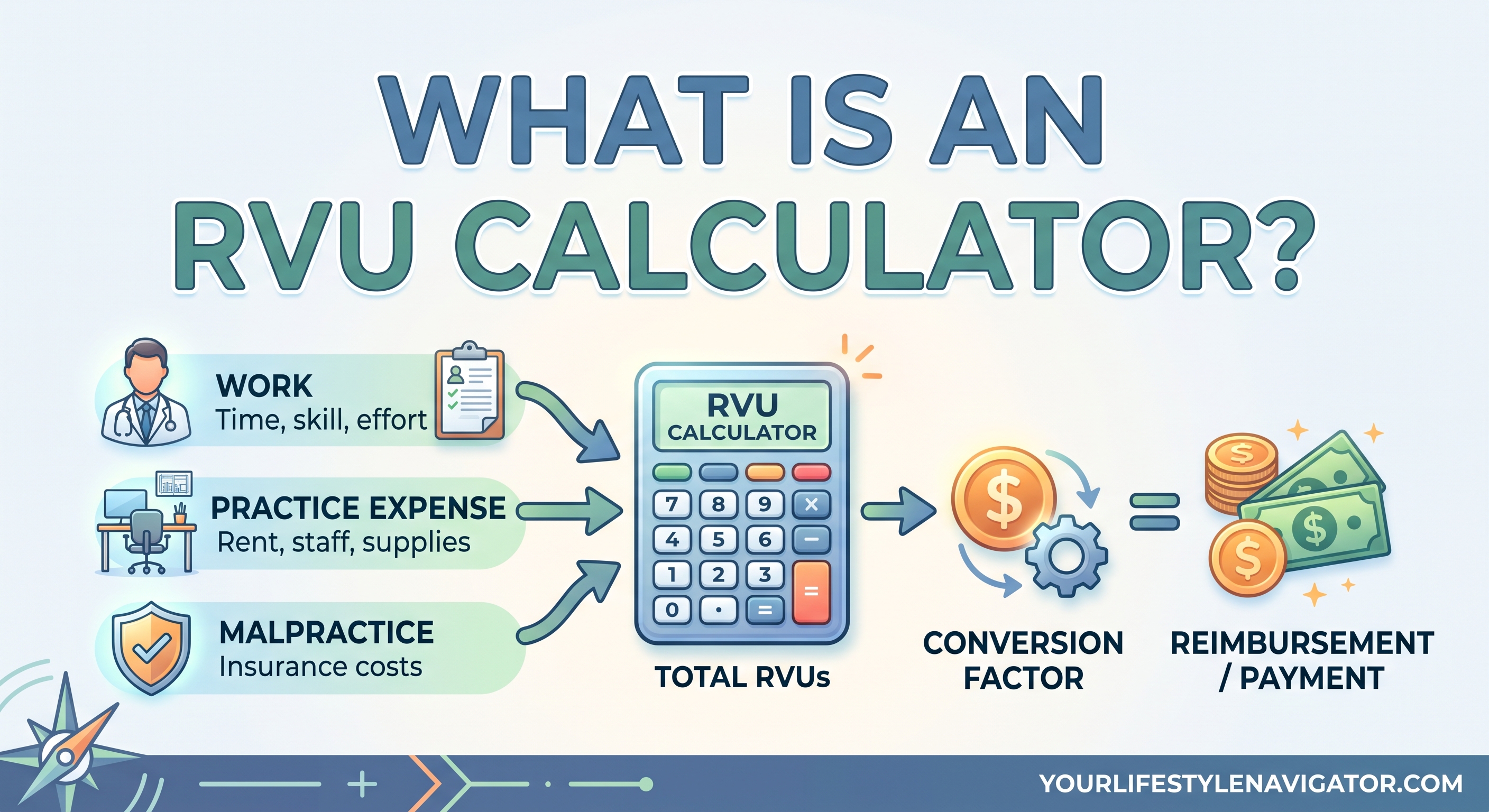
A Relative Value Unit (RVU) is the unit Medicare and most U.S. payers use to price a medical service. Every CPT code is assigned a total RVU value made of three components:
- Work RVU (wRVU) — physician time, skill, judgment, stress. ~52% of the total, and the piece most compensation plans are built around.
- Practice Expense RVU (PE) — overhead: rent, staff, supplies. ~44%.
- Malpractice RVU (MP) — liability coverage cost. ~4%.
CMS multiplies total RVU by a Geographic Practice Cost Index and the annual Conversion Factor ($33.4009 for 2026) to price Medicare payment. Most physician contracts use only the wRVU component and a negotiated $/wRVU rate.
The Problem: Most Physicians Have No Idea What Their wRVUs Are Actually Worth

"Rvu calculator" gets searched over 12,000 times a month because you're handed a formula and expected to evaluate it without a tool to check it.
- You can't tell if a job offer is fair — $52/wRVU sounds better than $45/wRVU until panel mix is factored in.
- Productivity reports don't match your gut sense of effort — CPT mix and documentation habits swing totals.
- Owners can't budget provider comp without knowing real cost per wRVU their payer mix supports.
- RVU assignments change every year — a formula built on last year's numbers is quietly wrong.
How to Calculate Your RVUs: Step-by-Step
- Pull your CPT code volume from your EHR or billing system.
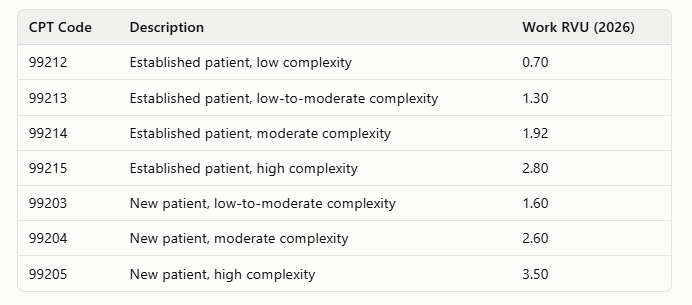
- Look up each code's current work RVU (CMS Physician Fee Schedule, or the table below).
- Multiply volume × wRVU per code.
- Sum across all codes.
- Apply modifiers — a -22 or -51 changes the math.
- Multiply total wRVUs × your contracted $/wRVU rate.
Quick-Reference: Common E/M Code Work RVUs
Types of RVU-Based Compensation Models
- Straight $/wRVU — flat rate per wRVU, sometimes with a base floor.
- Threshold model — base salary to a threshold, then a bonus rate above it.
- Tiered $/wRVU — rate increases at higher volume tiers.
- Blended RVU + quality model — part volume, part outcome metrics.
Benefits of Knowing Your RVU Numbers Cold
- Negotiating leverage with data, not vibes.
- Practice-level budgeting for provider compensation.
- Fair comparison across job offers.
- Early warning on burnout risk when required wRVUs creep up.
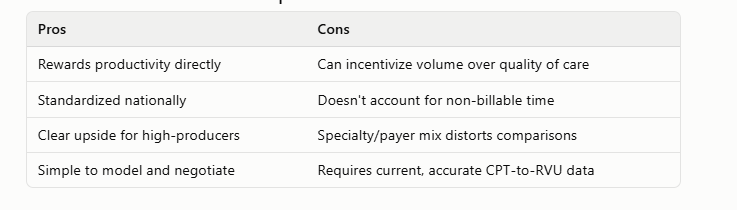
Pros and Cons of RVU-Based Compensation
The Governing Rules Behind RVU Values
RVU values come from the CMS Physician Fee Schedule, updated annually via the Medicare Physician Fee Schedule Final Rule, based on AMA RUC recommendations. The Geographic Practice Cost Index is reviewed periodically for regional cost differences. Most private-payer and hospital plans reference these same CMS values, which is why a federal RVU change ripples through nearly every physician compensation plan in the country.
Common Mistakes Physicians Make Reading Their RVU Reports
- Comparing raw wRVU totals across specialties.
- Forgetting modifiers change the math.
- Using last year's RVU table.
- Ignoring the conversion factor cut.
- Treating wRVU pay as the whole compensation picture.
What Healthcare Professionals Are Actually Asking
"Is my $/wRVU rate competitive, or am I lowballed?" Compare against specialty-specific MGMA/AMGA survey data, not anecdotes.
"Why did my compensation drop with the same patient volume?" Usually a CPT mix shift, a conversion factor change, or under-coding.
"Should I negotiate a wRVU floor?" Yes — a standard, reasonable ask for ramp-up protection.
"How is RVU different from patient volume?" RVUs weight for complexity and risk; volume treats every visit as equal.
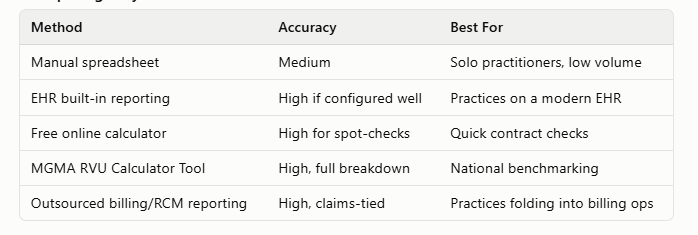
Comparing Ways to Track Your RVUs
Why Healthcare Business Owners Are Choosing Your Lifestyle Navigator
RVU math is never really about RVUs — it's about whether your compensation structure and financial engine actually support the outcome you want. Through the NEXT Framework™, John S. Smith Jr. helps healthcare entrepreneurs turn productivity metrics like wRVUs into a bigger financial picture — see how this connects to building personal wealth alongside your practice and to structuring provider pay through Elevate Wealth.
Frequently Asked Questions
1. What is a good $/wRVU rate in 2026?
Primary care typically runs $40–$55; procedural specialties $55–$90+. Benchmark against your specialty's MGMA/AMGA data.
2. How do I calculate my total wRVUs for the year?
Multiply each billed CPT code's volume by its current work RVU and sum.
3. Is RVU the same as revenue?
No — RVUs measure work intensity, not dollars, until multiplied by a conversion factor or $/wRVU rate.
5. Do RVU values change every year?
Yes, CMS updates the Fee Schedule annually.
6. What's the difference between work RVU and total RVU?
Work RVU is physician effort alone; total RVU adds practice expense and malpractice RVU.
Conclusion
An RVU calculator turns an abstract formula into a number you can negotiate with. If you're a healthcare practice owner trying to turn accurate RVU math into a stronger compensation structure or exit strategy, book a NEXT Strategy Session with Your Lifestyle Navigator and let's build the numbers behind your next move. For the accounting side of this, see our companion guide on choosing a CPA for your medical practice, and for the bigger-picture goal all this compensation math serves, read Thriving as a Healthcare Entrepreneur.
Related on Your Lifestyle Navigator: Elevate Wealth · Building Personal Wealth Alongside Your Practice · Scaling for Enterprise Value
Get in touch with us on our social media platforms for more: